


Key Takeaways
- Compare customer value with the cost to serve: Identify the accounts driving the highest AI costs, then determine whether the value they receive and their willingness to pay justify that level of consumption.
- Put an AI allowance inside the tier: Keep predictable subscription pricing, but define how much AI usage is included so a small number of heavy users can’t create unlimited costs.
- Give heavy users a clear way to buy more: Use prepaid credits or another paid consumption mechanism to let customers exceed their allowance without leaving you to absorb the additional AI costs.
Revenera’s latest Monetization Monitor surveyed 415 established software companies — businesses adding AI to products they already sell.
When asked how they charge, most either put AI in a higher-priced tier (40%) or include it at no extra cost (39%).
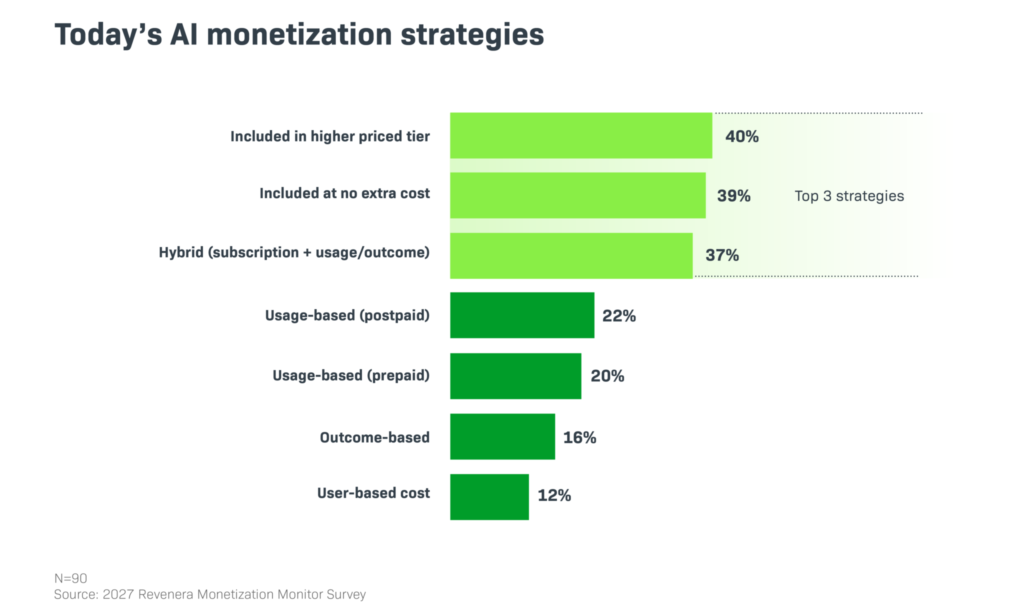
Both approaches give customers something they want: a predictable bill. That’s a reasonable priority. But it leaves these companies with an uncomfortable question: When a customer uses more AI than expected, who pays for it?
If the subscription stays fixed while the costs keep rising, you do.
Software companies have absorbed differences in customer usage for decades. What’s changed is how much those differences can cost.
Heavy Users Used to be Trivial
Traditional software could accommodate enormous differences in customer usage and value.
I might use Microsoft Word to open the occasional document. J.K. Rowling used it to write Harry Potter. We could pay the same price because the difference in what we cost Microsoft was small.
Software companies built their pricing around that logic. A few tiers captured some of the differences in customer value, without trying to charge each account exactly what it might be willing to pay.
You left money on the table with some customers. But serving a heavy user rarely meant watching your delivery costs climb with every action.
AI changes that.
Each additional request can carry an additional cost. And those costs can be extraordinarily concentrated.
Across our clients, from $10 million to $1B million in ARR, we repeatedly see roughly 1% of users (or fewer) accounting for 50–75% of total AI costs.
One business we worked with had about a million users. Roughly 900 of them, less than 0.1%, generated around 75% of its AI costs. Within that group, one account incurred $380 in costs for every $1 of revenue.
An average cost per user would have hidden the scale of that problem. But finding your most expensive users is only half the job. You also need to know whether the value they receive supports a price that makes them worth serving.
You Need to Understand Two Curves
Software companies have always had a value curve: some customers get far more value from the product than others.
AI adds a cost curve: some customers also cost far more to serve.
I call this the double hockey stick. Both curves can rise sharply at the top.
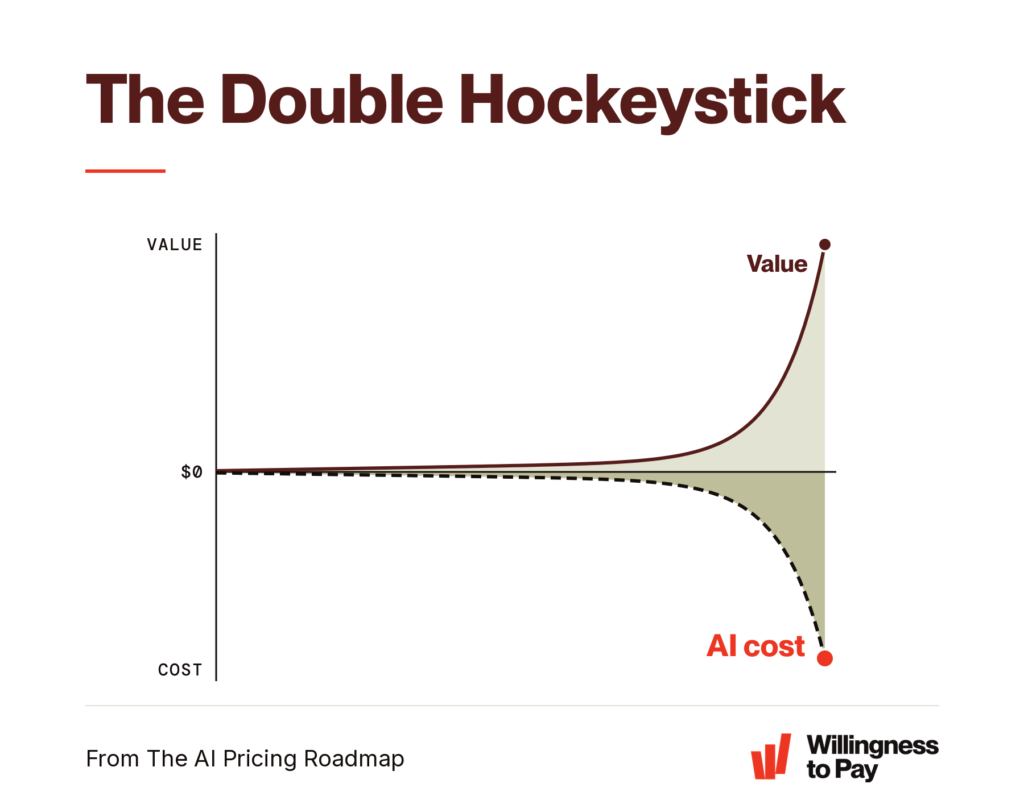
The crucial question is whether value is larger than cost.
Sometimes it is – this is what we might call ‘positive asymmetry’.
We worked with an AI company in e-commerce optimization whose largest customer paid about €400,000 a year and generated roughly €15,000 in AI costs. That’s an attractive account. High usage alone isn’t a reason to intervene.
But the account costing $380 for every dollar of revenue was different. There was no corresponding willingness to pay. Raising the price enough to cover their costs would simply cause them to churn – there was a negative asymmetry. The cost was larger than the value.
Positive or negative asymmetry requires different solutions. Positive asymmetry, where value is larger than cost, requires AI pricing models that can capture that value. Often based on some form of consumption or credits. Negative asymmetry, where costs are larger than the value, require usage limits that curb cost for the few outliers that produce the majority of the cost.
You therefore need to look at the distribution of value and cost across accounts, comparing the distribution of value to the distribution of cost and determine if you have more value than cost – and for whom! Until you do, even healthy revenue growth can give you a misleading picture of how well your AI offer is working.
If AI is Growing Revenue, is it Growing Profit?
Revenera found that 69% of respondents say AI features are growing revenue, while 41% say AI delivery costs are squeezing margins.
There’s no contradiction. AI can help sell subscriptions across a broad customer base while a small group of users consumes much of the resulting revenue.
More concerning is that 20% say they can’t measure AI’s effect on profitability, making it difficult to establish whether they are achieving a positive AI ROI.
The cost will arrive on the cloud bill either way. Understanding what it bought you: higher prices, better retention, more expansion – takes deliberate work.
Many companies lack the data to connect those dots. From the survey:
- 49% cite data availability and insights as a barrier to aligning price with value
- 49% cite difficulty understanding customer value drivers
- 41% still collect usage data manually or rely on engineering help
Yet the plan is to keep expanding the same pricing approaches. By 2028, 58% intend to expand AI in higher-priced tiers, and 45% intend to expand AI offered at no extra cost.
I understand the appeal. Three quarters of respondents manage ten or more products, with an average of four monetization models. Adding AI to a tier is a familiar move in an already complicated business.
But familiarity doesn’t tell you whether the economics work. And when companies struggle to measure those economics, it’s hard to know where a pricing change should begin.
That’s where the two curves become useful. They help you identify which customers fit comfortably within the subscription and which need a different arrangement. You can then focus the change where it matters, while keeping pricing simple for everyone else.
And having a level of data maturity that lets you track real time costs on an account level, can be a base requirement to install fair usage limits as a critical guardrail. Or to meter consumption, so that it can form the baseline of a pricing sophisticated enough to truly monetize the value your product delivers – even at the edge cases.
Predictable Pricing with Defined AI Usage
Most customers shouldn’t need a new invoice or a complicated pricing explanation just because you added AI.
The goal is to preserve that simplicity while managing the small number of accounts that can materially change your costs.
I’d start with three steps.
1. Compare customer value with the cost to serve.
Rank accounts by the value they receive and their willingness to pay, using the best evidence available. Then rank them by AI cost.
Look closely at the top of each list. Which expensive accounts support strong commercial relationships? Which consume heavily without generating enough revenue (or showing a credible path to it)?
You don’t need perfect, real-time reporting to begin. A quarterly account-level snapshot can reveal where to investigate.
2. Put an allowance inside the tier.
Keep the subscription price, but define how much AI usage it includes.
Set the allowance high enough that most customers rarely think about it. Covering 95% of accounts might be a useful starting point, but the right threshold depends on your usage patterns and margins.
The allowance makes the offer explicit: this is what the subscription buys.
3. Give heavier users a clear way to buy more.
Prepaid credits are one option. Customers buy a known amount, use it over time, and choose whether to replenish it.
For typical customers, little changes. For heavy users, additional consumption becomes a visible purchasing decision.
Credits still need clear conversion rates, understandable balances, and timely usage alerts. They offer predictability only if customers can tell what they’re buying and how quickly they’re using it.
As part of a broader AI pricing strategy, an included allowance and a clear way to buy more can preserve the simplicity of a subscription while putting a boundary around its costs. That helps explain why usage components and credit systems are appearing on more SaaS pricing pages.
Predictability Has to Work on Both Sides
Our team at PricingSaaS tracks the pricing pages of 4,332 SaaS and AI companies. Of those, 1,089 (just over a quarter) have a usage-based component, and 320 have a credit system.
The appeal is straightforward. A subscription can cover routine use, while credits or another paid usage mechanism handle demand above that level.
That gives companies a way to retain familiar pricing without absorbing unlimited consumption.
Revenera’s “Quiet Majority” is right to care about predictable customer bills. But a fixed customer bill doesn’t make the underlying business predictable. Without an allowance or another boundary, it transfers the uncertainty to the supplier.
For traditional software, that was often an affordable trade. With AI, you need to know what it costs.
Before your next pricing discussion, identify the accounts generating the most AI cost. Then ask whether they’re also the accounts generating, or willing to pay for, the most value.
That comparison will tell you more than another debate about whether the next tier should cost $49 or $59.
This is one of the central arguments in my next book, The AI Pricing Roadmap, the follow-up to The Pricing Roadmap. Out December 1 and available for preorder, it explores how to connect customer value, pricing metrics, and usage guardrails in practice.
FAQs
What is positive versus negative asymmetry in AI pricing?
Positive asymmetry occurs when the value an account receives from AI is greater than its cost to serve, giving the producer room to capture more value through consumption charges, credits, or a higher-priced package. Negative asymmetry occurs when delivery cost exceeds the customer’s value or willingness to pay. That account may require usage limits or a different product configuration rather than a price increase. Understanding this distinction is central when considering how to monetize AI.
Why is average AI cost per user a poor basis for setting a fixed price?
An average conceals the distribution of consumption. If a very small group generates most AI costs, combining those users with thousands of light or inactive users can make the product appear profitable even while individual accounts lose money. Account-level customer data analysis reveals the outliers and shows where pricing, packaging, or usage controls need attention.
How should software companies decide which customers need AI usage guardrails?
Start by ranking accounts according to AI consumption, delivery cost, revenue, and evidence of customer value. Accounts with high costs and strong willingness to pay may be candidates for credits or paid overages. Accounts with high costs but limited value may need rate limits, workflow restrictions, or a firm allowance. Reliable product usage data makes it possible to apply these controls selectively instead of complicating the offer for every customer.
How often should AI cost and customer value be compared at the account level?
A quarterly account-level review is a practical starting point, with more frequent monitoring for rapidly growing or unusually expensive workloads. The comparison should be refreshed when model costs, feature design, customer behavior, or commercial terms change. Mature commercial monetization analytics can help teams identify material changes sooner and distinguish temporary spikes from persistent economic problems.