


Consumption-based pricing is the hottest topic in tech, with software market leaders adopting usage-based strategies to align pricing with customer value while recovering the variable costs of delivering AI-powered services.
As reported in Revenera’s Monetization Monitor 2026, 70% of those who offer AI capabilities face margin pressure, prompting 52% to introduce some form of consumption-based pricing as a result.
I was recently joined by Revenera’s General Manager, Nicole Segerer, to discuss this topic and gain her insights on what global technology leaders need to know as they navigate the shift to consumption. You can watch the recording below:
How to Launch Consumption-Based Pricing
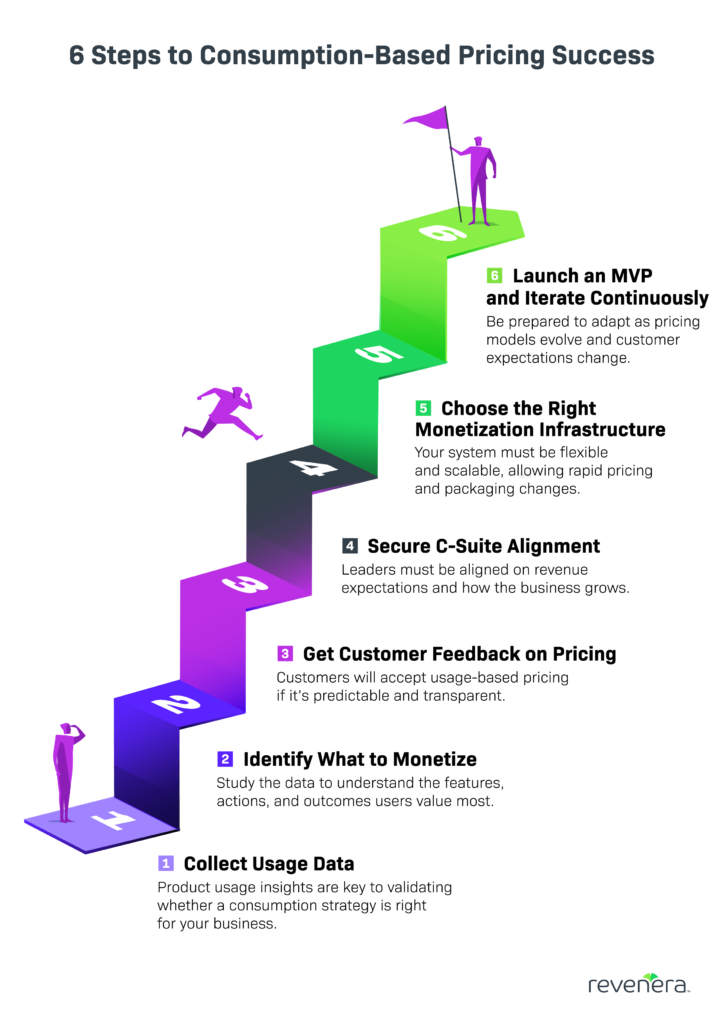
Inspired by Nicole’s presentation, here’s a practical step-by-step guide to launching consumption-based pricing models:
Step 1: Collect Usage Data
Rather than relying on assumptions about which features users value most, gather telemetry and usage data to build an accurate picture of behavior.
Look beyond overall usage and identify patterns such as peak demand, seasonality, feature adoption, and differences between customer segments. For example, some customers may use a product consistently throughout the year, while others experience significant spikes at quarter-end or during major projects. These insights help determine whether a usage-based monetization strategy will create value for both your business and your customers.
Where possible, begin collecting usage data several months before launch. This allows you to validate assumptions, identify unexpected trends, and refine your approach before pricing changes are introduced.
2. Identify What to Monetize
Once you understand how customers use your product, the next step is deciding what they should actually pay for. This is one of the most important decisions when designing a consumption-based pricing model, and often one of the most challenging.
Start by clearly defining what constitutes “usage.” Depending on your product, that could mean API calls, workflow transactions, storage, users, compute time, reports, or another measurable outcome. The right metric should be easy for customers to understand, directly tied to the value they receive, and practical to measure consistently.
From there, determine how customers will purchase and consume that usage. Will you offer prepaid credits or postpaid billing? Will consumption be included within subscription tiers, or will customers pay only for what they use? How will overages, grace periods, credit expiration, and renewals be handled?
These decisions shape your commercial success, giving your business the flexibility to evolve pricing as products and customer expectations change.
3. Get Customer Feedback on Pricing
Before launching a new pricing model, validate it with customers. Even the most carefully designed consumption-based pricing models will struggle if customers don’t understand how they work or believe they’re fair.
Conversations should focus on more than pricing alone. Test whether the consumption metric feels intuitive, whether customers can accurately budget for usage, and whether they have enough visibility into their usage. Real-time dashboards, remaining credit balances, and administrative controls all help customers manage spend with confidence.
It’s also valuable to present several consumption-based pricing examples during customer interviews. Comparing approaches such as prepaid credits, subscription allowances with overages, or pure pay-as-you-go billing often reveals which model customers find easiest to understand and most attractive.
Finally, avoid switching overnight. A warm-up period where customers can see their usage without being billed allows them to become familiar with the new model. Combined with pilot programs and early feedback, this reduces resistance and provides valuable insights before a full commercial rollout.
4. Secure C-Suite Alignment
A new software monetization strategy affects far more than product management. Finance, sales, customer success, operations, and executive leadership all have a stake in its success, making executive alignment essential before launch.
Document exactly how consumption will be measured, billed, and governed, then secure agreement across the leadership team. Without a shared definition of usage, disagreements often emerge late in the project, delaying implementation and creating unnecessary complexity.
Build conservative, expected, and optimistic revenue scenarios to demonstrate how the model performs under different customer usage patterns. This helps finance teams understand revenue predictability while giving leadership confidence in the business case. It’s equally important to consider impacts on annual recurring revenue, revenue recognition, renewals, forecasting, and existing customer contracts.
Sales teams also require enablement. Selling a consumption model involves different conversations around value, expected usage, budgeting, and growth. By aligning every stakeholder early, organizations significantly improve their chances of a successful launch.
5. Choose the Right Monetization Infrastructure
Technology decisions made early in the project can determine whether a pricing strategy scales successfully or becomes difficult to maintain. While it may be tempting to build a quick solution using existing systems, short-term fixes often create operational challenges as pricing evolves.
Instead, choose monetization infrastructure that supports future flexibility. Your platform should accurately capture usage, manage entitlements, handle both online and offline environments where required, and provide customers with clear visibility into their consumption. As AI offerings continue to evolve, pricing models are unlikely to remain static, so your AI monetization platform must be capable of adapting alongside your business.
Auditability is equally important. Customers expect accurate billing and may question unexpected charges. Reliable usage records and transparent reporting help build trust while reducing disputes and support overhead.
Selecting the right technology from the outset gives your organization the foundation needed to support new commercial models without repeatedly rebuilding core monetization capabilities.
6. Launch an MVP and Iterate Continuously
Rather than attempting a company-wide rollout on day one, start with a minimum viable product. Launch with a limited group of customers, a specific product line, or a single use case, then monitor results before expanding.
Early pilots allow you to validate assumptions around pricing, customer adoption, usage patterns, and operational processes. Review how customers consume credits or other usage metrics, evaluate whether pricing aligns with perceived value, and refine rate tables where necessary. Small adjustments made early often prevent much larger issues later.
Most importantly, recognize that consumption-based pricing is never finished. Customer expectations, AI capabilities, competitive offerings, and business objectives will continue to evolve. Build regular review cycles into your commercialization strategy so pricing, packaging, and usage metrics can be refined using real customer data.
Organizations that treat launch as the beginning of an ongoing optimization process are far better positioned to maximize customer value, improve profitability, and keep pace with changing market demands.

Revenera Monetization Monitor: 2026 Outlook
501 senior leaders at global technology companies share their thoughts on monetization trends for 2026 and beyond. See the results >>>
Consumption-Based Pricing Models 101
For many technology companies, consumption-based pricing isn’t replacing subscriptions, it’s complementing them. Rather than choosing between recurring subscriptions and consumption, organizations are increasingly adopting hybrid monetization strategies that combine predictable recurring revenue with the flexibility of usage-based charges.
A subscription might include a baseline level of consumption, with additional usage billed through credits or overages. This approach gives customers greater flexibility while allowing software producers to align revenue more closely with the value delivered, particularly for AI functionality where consumption can vary significantly.
Revenera’s Dynamic Monetization helps software producers design, launch, and evolve these hybrid consumption-based pricing models by enabling them to:
- Support multiple monetization models from a single platform, including subscriptions, consumption, prepaid credits, overages, and hybrid pricing.
- Capture and manage usage data to accurately measure consumption, enforce entitlements, and automate billing across SaaS, on-premises, and AI offerings.
- Adapt pricing and packaging over time without rebuilding monetization infrastructure, making it easier to introduce new products, pricing metrics, and commercial models as customer needs evolve.
For new insights on growing revenue in the age of agentic AI, please download:
The Product Leader’s Guide to Consumption-Based Monetization