


“Nothing frustrates me more than feeling like I’m getting a bad deal.”
That line, taken from the recent OnlyCFO piece, 2026: The Year of Churn, perfectly captures the growing tension between SaaS vendors and their customers.
The author calls out “stupid pricing models” as a key driver of churn, particularly in an AI-driven world where traditional seat-based or named user approaches are breaking down. It’s a blunt assessment, but an accurate one.
This is not just a pricing conversation. It is a trust conversation.
And increasingly, software pricing models are the fastest way to either build or destroy that trust.
The Real Problem with Software Pricing Models Today
The shift away from seat-based pricing is both necessary and inevitable. As AI changes how software is consumed, the notion of pricing per user becomes increasingly disconnected from value.
But as the OnlyCFO article highlights, many companies are reacting, not redesigning.
Instead of building better software pricing models, they are:
- Translating old pricing logic into new consumption formats
- Introducing opaque metrics customers don’t understand
- Embedding hidden price increases into “modern” pricing transitions
The result is predictable: customers feel like they’re getting a bad deal.
And when that perception sets in, churn is no longer a risk. It becomes a rational decision.
Why AI Has Broken Traditional Pricing Models
AI fundamentally changes the economics of software.
- Costs become variable (compute, tokens, API calls, MCP usage)
- Usage becomes unpredictable and differs a lot more between customers
- Value is delivered dynamically, not uniformly
Yet many pricing strategies remain static.
This creates a disconnect:
- Vendors are exposed to margin risk
- Customers are exposed to unpredictable spend
- Neither side feels fully in control
Revenera’s industry research report, Monetization Monitor, shows that aligning price with value is cited as a key challenge among respondents.
The conclusion is clear: the issue is not consumption pricing itself, but poorly executed consumption pricing strategies.
From “Stupid” to Strategic: Rethinking Software Pricing Models
The OnlyCFO article offers three important warnings:
- Pricing must involve cross-functional teams
- It must be tested and iterated continuously
- And companies must treat existing customers fairly
These are not tactical suggestions. They are strategic requirements.
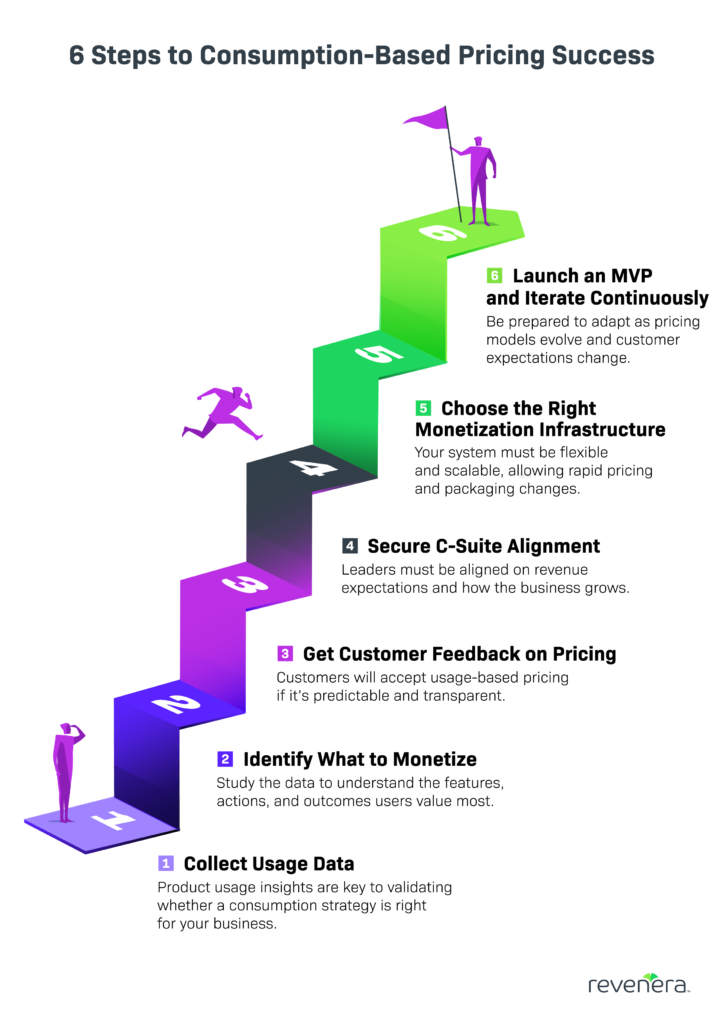
At Revenera, we see leading software companies applying a structured framework to meet these requirements – turning pricing from a churn driver into a growth lever. I recently presented the following at an industry conference for pricing professionals:
A Six-Step Framework for Smarter Software Pricing Models
To succeed in the AI era, software pricing models must be deliberately designed, not improvised.
1. Use data to validate assumptions – and correct them
Every pricing model starts with assumptions:
- How customers will use the product
- What they value most
- How much they are willing to pay
In reality, usage patterns are highly variable – especially with AI.
Companies must continuously analyze:
- Usage patterns and spikes
- Customer cohorts
- Behavior over time
This allows them to refine pricing models so they better reflect real-world value.
2. Define usage in customer terms – not internal terms
The most common failure in modern pricing is choosing metrics that reflect internal cost drivers rather than customer value.
Customers don’t buy credits, tokens or usage. They buy outcomes.
Effective software pricing models ensure:
- The metric is meaningful to the customer
- The relationship to value is clear
- The customer can predict and influence their spend
- The vendor is able to leverage multiple metrics and fine-tune to get it right, which is inevitable in a world where cost structures are changing dramatically in short cycles.
If the metric fails on any of these dimensions, it will feel unfair.
3. Test with customers and continuously iterate
“You can’t set it and forget it anymore.”
This observation is exactly right.
Pricing must now be treated as an evolving system:
- Pilot new models with select customers
- Measure perception of fairness and predictability
- Adjust thresholds, tiers, and structures
- Iterate based on real-world usage
Leading organizations now iterate pricing with the same discipline they apply to product development.
4. Align across Product, Finance, Sales, and Leadership
One of the most important points raised in the OnlyCFO article is the need for cross-functional involvement.
Pricing is no longer owned by a single team. It touches:
- Product (value definition)
- Finance (revenue and margin impact)
- Sales (positioning and negotiation)
- Customer Success (retention and expansion)
Without alignment, even well-designed software pricing models break down in execution.
5. Build transparency into the technology itself
The perception of a “bad deal” is often driven not by cost, but by lack of visibility.
Customers want to know:
- What they are being charged for
- How those charges are calculated
- How to control their usage
- Have real-time insight into consumption and trends, not monthly reporting or updates from their account team
The right monetization infrastructure enables:
- Real-time software usage tracking
- Clear billing logic
- Customer-facing dashboards
- Customer controls (determine who can use how much, set boundaries)
- Auditability
Without this, even the best software pricing models feel opaque and unpredictable.
6. Start simple and evolve deliberately
Another common trap is overengineering pricing at launch.
The better approach:
- Start with a simple pricing structure
- Introduce guardrails (caps, tiers, credits)
- Monitor behavior
- Iterate based on outcomes
This approach builds trust because simplicity and predictability are the foundation of perceived fairness.
The Most Overlooked Risk: Existing Customers
The OnlyCFO article makes a critical point: pricing changes often feel like a bad deal for existing customers – especially CFOs.
This is where many pricing transformations fail.
Existing customers:
- Have budget expectations based on the old model
- Are highly sensitive to pricing changes
- Quickly identify hidden price increases
If they feel penalized, churn becomes immediate.
The most successful companies:
- Protect or grandfather existing pricing where possible
- Introduce new models as optional pathways
- Communicate openly and proactively
- Provide incentives during transition
Fairness is not just good practice – it is a retention strategy.
Fix the Model, Fix the Churn
The takeaway from the OnlyCFO perspective is clear:
Bad software pricing models are not an inconvenience – they are a primary cause of churn.
But there is an important nuance.
There are no inherently “stupid” pricing models.
There are only models that are:
- Poorly aligned to value
- Poorly communicated
- Poorly executed
In an AI-driven world, the bar for getting pricing right is significantly higher.
The software companies that succeed will be those that design pricing with the same rigor as product and go-to-market strategy.
Because today, pricing is no longer just a monetization mechanism.
It is a core part of the customer experience – and one of the most powerful levers you have to reduce churn, build trust, and drive long-term growth.
For further advice on growing revenue in the age of AI, please read:
The Product Leader’s Guide to Consumption-Based Monetization