
For 20 years, software companies placed billing systems at the center of their commercial architecture.
That made sense when pricing was simple. Customers bought subscriptions, contracts defined entitlements, and your billing system generated invoices. Revenue was largely predictable.
Today, that approach is breaking down. Credit-based pricing models, connected devices, AI capabilities, and outcome-based strategies have changed the economics of software. Yet many companies are still trying to solve monetization problems with billing systems.
That is becoming an expensive mistake.
Billing tells you what happened.
Monetization determines what is allowed to happen.
The distinction matters because one happens after value is consumed. The other determines whether, how, and on what commercial terms consumption can occur.
What is Monetization?
Monetization is the discipline of defining, delivering, and optimizing how products create commercial value, aligning pricing, packaging, usage models, and customer outcomes to drive sustainable growth, profitability, and long-term business performance.
Why Billing Systems Worked
Traditional software businesses sold per-user subscriptions, annual licenses, maintenance contracts, and fixed recurring services.
A contract defined what the customer had purchased. Consumption was predictable, and billing calculated what was owed while managing invoicing, revenue recognition, tax, and collections.
The product delivered value. Billing systems recorded the financial outcome. That was enough because there was little uncertainty between signing the contract and generating the invoice.
AI Changed the Economics
AI introduces a cost every time a customer consumes value. A prompt consumes tokens or credits. A model performs inference. An agent executes workflows. A single workflow may trigger dozens of downstream services.
Two customers on the same plan can therefore create dramatically different costs. One may generate hundreds of requests per month; another may generate millions. Commercially they may look similar, but economically they are not.
As software shifts toward consumption-based pricing, businesses must align customer value, operational cost, and revenue. Billing can calculate the invoice. It cannot control the behavior that created it.
The Monetization Control Gap
Consider a customer with a $500 monthly AI allowance. At month end, the billing platform reports that the customer consumed $2,000 of AI services.
The invoice may be accurate, but it arrives $1,500 too late.
The important questions should have been answered earlier: Should the customer have been stopped? Should prepaid credits have been drawn down? Should overage pricing or additional approval have applied?
Those decisions shape profitability, customer experience, and commercial outcomes. Billing systems were never designed to make them.
This is Already Happening
Recent incidents show that the control gap is not theoretical. AI consumption can move faster than conventional budgeting, monitoring, and approval processes.
Uber: a full-year AI budget consumed by April
Uber exhausted its entire 2026 AI budget by April after Claude Code adoption spread across roughly 5,000 engineers faster than its financial models anticipated. The tools were being used as intended, but token-based licensing outpaced the budget. The issue was not invoice accuracy. It was the absence of timely controls over aggregate consumption.
Amazon: $1.8 million spent before the overrun was detected
An Amazon project using Claude Sonnet to match author information with product listings reportedly cost $1.8 million, ran 860% over budget, and went undetected for five months. The project never launched. The incident shows how an AI workload can continue consuming value while conventional financial controls remain retrospective.
Air Canada: an AI interaction created a financial obligation
Air Canada was held liable after its website chatbot gave a customer incorrect information about a bereavement fare refund. The tribunal ordered the airline to compensate the customer. The billing system did not fail; the commercial commitment had already been made by the customer-facing system.
These cases have different causes, but the pattern is consistent: by the time the cost or obligation appears in a financial system, the economically important decision has already occurred.
Monetization Happens Before Consumption
Before value is delivered, a modern digital business must decide whether the customer is entitled, has available budget or credits, can use the requested feature, is compliant with policy, and should be charged for the action.
These are monetization decisions. By the time an invoice is produced, they have already been made. Monetization therefore must sit closer to the product and operate in real time.
Credits Expose the Problem
Credits simplify complex consumption models by separating the customer-facing commercial unit from the underlying infrastructure cost. Customers can understand 10,000 credits, one million tokens, or 100 API calls. They should not need to understand GPU, inference, storage, or network costs.
But credits require real-time balances, authorization, draw-down, replenishment, policy enforcement, and governance. Those are monetization capabilities, not billing system functions.
The New Commercial Stack
The architecture needs a dedicated control layer between the product and the financial systems:
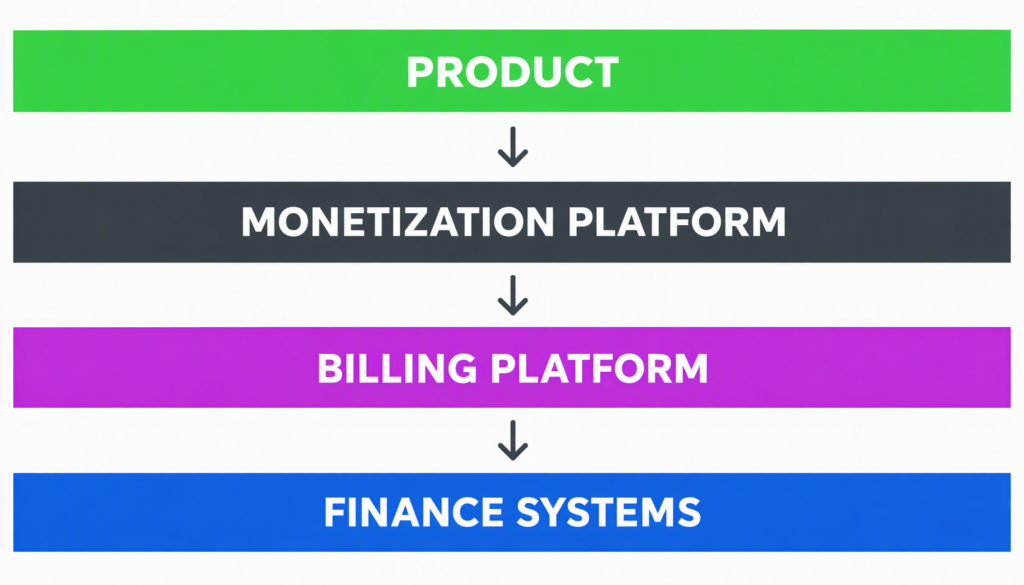
The monetization layer owns entitlements, metering, credits, rating, pricing policy, budget controls, usage governance, and commercial experimentation. Billing remains essential, but with a clearer role: it is the system of financial record, not the system of commercial control.
The Bottom Line
For years, software companies asked:
“How do we bill for what happened?”
The more important question today is:
“How do we govern and monetize value before it is consumed?”
That is not a billing problem. It is a monetization problem.
Companies that recognize the difference will gain greater control over profitability, AI pricing models, and customer experience. Those that do not will continue to discover that an accurate billing system invoice is a poor substitute for commercial control.
If you’d like expert advice on how to modernize your monetization stack, please contact Revenera today.