
What is Usage-Based Billing?
Usage-based billing is the process of charging customers according to how much of a product or service they consume. Rather than paying only a fixed fee for access, customers are charged against a measurable unit such as API calls, transactions, data storage, compute time, completed workflows or generated content.
For software and AI producers, usage-based billing connects product consumption directly to revenue. It requires accurate usage data, pricing rules and a way to validate what customers are entitled to consume. Forrester identifies billing as one of three capabilities that combine to support usage-based monetization:
- Entitlement management and control: Defining and enforcing what customers can access or consume.
- Usage data management: Collecting, validating, normalizing and distributing consumption records.
- Billing: Calculating charges and managing financial transactions.
These capabilities are particularly important for AI services, where every unauthorized request can generate infrastructure costs. Producers need to validate entitlements, check available AI credits and enforce consumption limits before granting access.
Usage-based billing is also known as consumption-based billing, metered billing or pay-as-you-go billing. These terms are often used interchangeably because they all connect customer charges to recorded consumption.
How Does Usage-Based Billing Work?
An effective usage-based billing process must connect product activity to the correct customer, apply the relevant commercial terms and translate consumption into accurate charges. It typically involves six steps:
- Define the usage metric: Select a unit that customers can understand and that reflects the value delivered, the cost of providing the service or both.
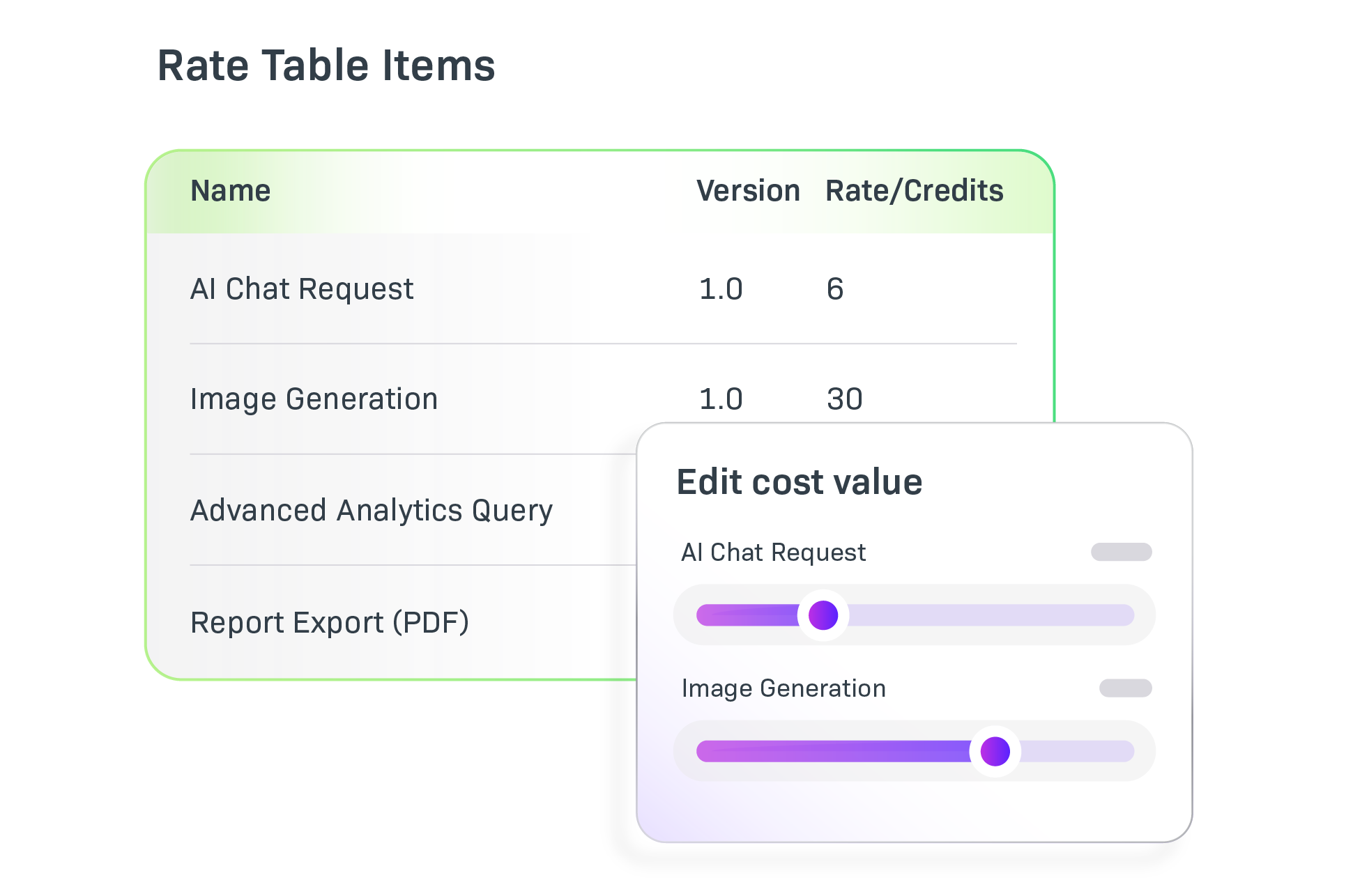
- Establish commercial rules: Define how consumption translates into charges, including unit rates, subscription allowances, credit allocations, volume tiers, drawdowns and overage conditions.
- Authorize consumption: An entitlement management system checks whether a customer can access a product, feature or service and whether sufficient usage allowances or credits are available.
- Capture and measure consumption: The product or an associated metering system records usage events, including the customer, resource, quantity and time of consumption. Records must be accurate and associated with the appropriate customer and product.
- Calculate charges and process billing: Consumption is evaluated against the applicable pricing rules and allowances. Usage records are passed to billing and financial systems for rating, invoicing, payment processing and revenue recognition.
- Provide usage visibility and control: Dashboards, balances, notifications and spending limits help customers monitor consumption and manage costs, while giving producers greater control over usage and revenue.
Customers may be charged in arrears through postpaid billing or purchase credits in advance through prepaid billing. Hybrid approaches combine subscriptions or included allowances with additional charges for consumption beyond an agreed limit.
Common Usage-Based Billing Models
Different pricing models determine how customers pay for consumption. The right approach depends on the product, customer expectations, cost structure and how closely charges should align with actual usage. Common approaches include:
- Pay-as-you-go: Customers pay for each unit consumed, with charges typically calculated and invoiced after consumption has taken place.
- Tiered pricing: Different rates apply as usage crosses defined thresholds.
- Subscription with overages: A recurring fee includes a consumption allowance, with additional usage charged separately.
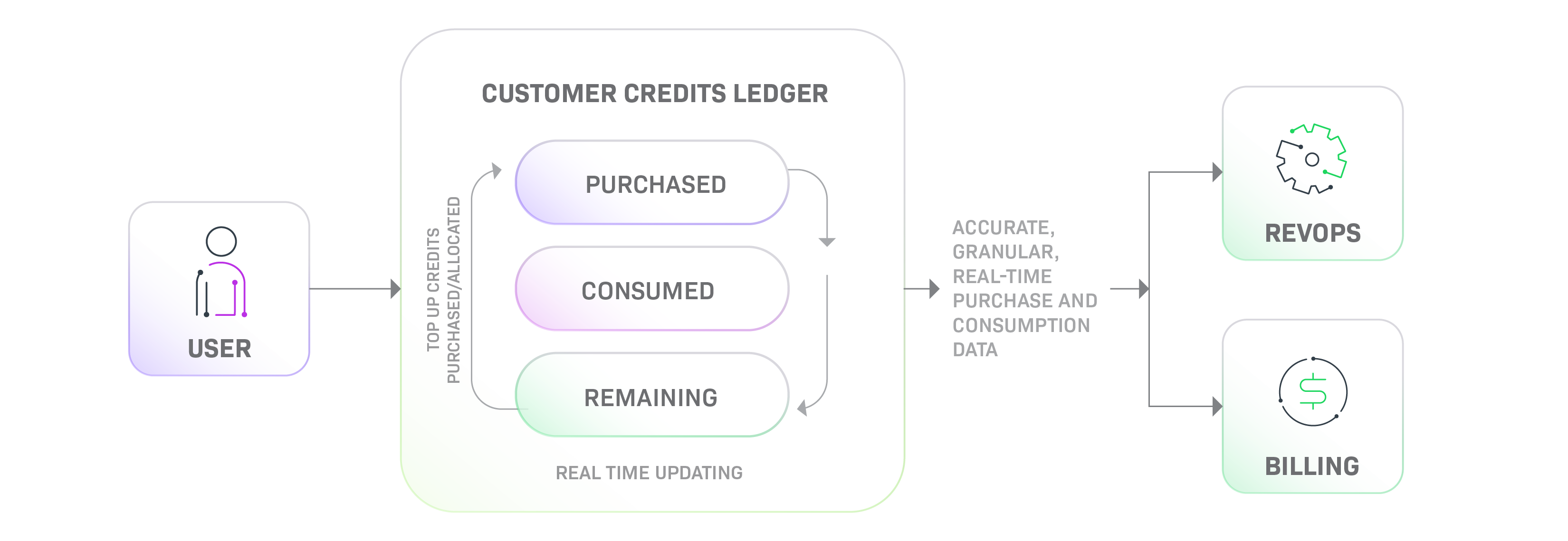
- Prepaid credits: Customers purchase an allowance that is drawn down as services are consumed.
- Hybrid pricing: Subscriptions and credits are combined to balance predictable recurring revenue with consumption-driven growth as part of a hybrid monetization strategy.
- Outcome-based pricing: Charges are linked to a measurable result, such as a completed transaction or successful outcome, rather than an underlying technical activity.
These models can be combined to accommodate different products and customer requirements. For example, a software producer might include AI credits in a subscription and charge for additional consumption once the allocation is exhausted.
Supporting these approaches requires flexible pricing rules, accurate usage tracking and effective entitlement management software.
What are the Benefits and Challenges?
Usage-based billing can align price more closely with customer value, lower barriers to adoption and create opportunities for revenue to grow with consumption. Customers pay according to their usage, while software producers can introduce more flexible pricing, monetize increased adoption and recover variable delivery costs such as cloud infrastructure and AI inference.
However, usage-based billing models also introduce complexity. Producers must select meaningful usage metrics, process consumption data accurately and manage greater revenue variability, while customers need clear visibility to avoid unexpected charges. Prepaid credits, spending limits, included allowances and threshold notifications can provide greater predictability and help maintain customer trust.
Why is a Billing System Not Enough?
Billing systems can handle charges, invoices, payments and financial reporting. Many also provide metering, rating, product catalogs and pricing rules. However, calculating what customers owe is different from controlling what they can access or understanding how products are used, which is why billing systems can't solve monetization alone.
A billing platform may record a purchase and calculate overages without validating whether a particular request is authorized or enforcing access limits within an application or device. These product-facing controls require entitlement management that operates at the point of consumption across SaaS, on-premises, edge applications and connected devices. In disconnected or air-gapped environments, the same rights may need to be enforced locally until usage data can be synchronized with central systems.
Billing data alone may show how much a customer used without preserving the context needed to interpret that usage. A record showing that a customer consumed 5,000 credits may provide the information needed to calculate a charge, but understanding which features they used, how frequently they used them and which products or entitlements were involved provides a clearer view of their behavior. Product, customer success, sales and pricing teams can use that context to assess adoption, entitlement utilization and expansion potential.
How Does Revenera Support Usage-Based Billing?
Revenera's software monetization platform complements billing and financial systems by connecting product entitlements, access controls, consumption, monetization rules and usage intelligence. This gives software producers the capabilities to manage how customers access and consume their products, while connecting that activity to commercial processes.
The platform supports the product-facing requirements of usage-based monetization, including the ability to:
- Authorize consumption and enforce product access, allowances and contractual limits.
- Support prepaid, postpaid and hybrid strategies, combining subscriptions and credits for cross-portfolio access and AI pricing models.
- Configure rate tables, credit values, drawdowns and overage conditions.
- Validate available balances and enforce hard or soft consumption limits.
- Track usage by customer, product, feature, entitlement or deployment.
- Provide customer-facing analytics that give users visibility into consumption, entitlement utilization and remaining balances. This helps customers monitor usage, manage costs, understand the value they receive and make informed decisions about their software consumption.
- Deliver contextual usage data to billing, finance, CRM and other business systems, giving internal teams greater insight into product adoption, customer behavior and expansion opportunities.
Revenera supports real-time or scheduled usage collection, depending on the product and deployment environment. Its monetization capabilities span SaaS, AI, on-premises software, intelligent devices, edge applications and disconnected environments.
Revenera is not a replacement for financial billing and payment systems. The monetization platform addresses the product-facing monetization requirements that billing alone cannot cover, helping producers control consumption, manage customer entitlements and turn usage data into actionable business insights.
Building a usage-based monetization strategy requires more than selecting a pricing model. Software producers need the technology to measure consumption, manage entitlements, control access and connect product usage to commercial systems. The following resources explore these requirements in more detail:
Usage-Based Billing FAQs
When evaluating the best billing system for usage-based pricing, you need to consider what aspects of monetization you need to address, such as system integrations, usage data tracking, and entitlement management capabilities to validate and control consumption before charges are calculated. Rather than looking at billing in isolation, examine how your wider monetization infrastructure supports flexible rating rules and different commercial models, including subscriptions, credits, and overages, while also handling large volumes of usage events reliably.
Choosing the best usage-based billing platform for AI requires looking beyond billing alone and considering the full monetization process. This includes how customers consume AI services, how producers manage costs, and whether the wider architecture can authorize AI requests, validate credit balances and enforce consumption limits before costs are incurred. Billing software for AI companies should also accommodate usage metrics such as token consumption, model requests, generated content, compute time and agent actions, as well as prepaid credits, spending limits and detailed usage tracking. These are core capabilities of Revenera's AI Monetization Platform.
To understand how to automate usage-based billing, connect product usage data with systems that identify the customer, validate entitlements, measure consumption and apply the relevant pricing rules. Automated workflows can then aggregate usage records and send accurate charges to billing systems for invoicing and payment processing. Integrating these capabilities reduces manual processing, improves billing accuracy and makes it easier to scale as consumption grows.
Several usage-based billing tools offer real-time or near-real-time usage tracking. When evaluating them, consider whether they simply record consumption or also connect usage to customer entitlements, credit balances and spending limits. Revenera supports real-time or scheduled usage collection, depending on the product and deployment environment, and provides contextual usage data for downstream billing and commercial analysis.
Usage-based billing software for SaaS should support subscriptions, usage allowances, overages, prepaid credits and flexible pricing rules. It should also handle high volumes of usage events and integrate with entitlement management systems when customer access and consumption limits need to be enforced within the application. A usage-based billing solution may combine these capabilities or connect specialist systems to an existing billing platform.
When you compare entitlement management systems with usage-based billing platforms, focus on where control takes place. Billing platforms calculate charges and manage financial transactions. Entitlement management solutions govern what customers can access, how much they can consume, and what happens when an allowance or contract expires.
Revenera’s entitlement management system connects customer agreements with product-level access and consumption controls. It can be used alongside a usage-based billing platform to manage entitlements, validate customer rights, enforce limits, and provide appropriate usage records to downstream billing systems.
Yes. Software operating in disconnected environments can use locally enforced entitlements and usage collection mechanisms to manage consumption without continuous connectivity. Usage records can then be transferred to centralized systems when connectivity or the deployment model allows. This is particularly important for embedded software, industrial devices, edge applications and air-gapped environments.
Resources
Report
The Definitive Technology Guide to Monetizing Usage and AI Directly
Get the Forrester report and evaluate whether your technology stack is ready for the next generation of software monetization.
Webinar
AI Monetization in 2027: Pricing, Adoption & Profitability
Wednesday, December 9
Discover how 415 technology leaders are approaching AI pricing, customer adoption and profitability, and what the findings mean for your software monetization strategy.
Webinar
Mastering AI Pricing and Monetization Strategies
Join Revenera experts to discover how to build a flexible, data-driven AI monetization strategy that supports growth while protecting profitability.
Report
IDC Market Perspective: The Rise of Monetization Operations
Discover Monetization Operations, an emerging discipline designed to govern how organizations design, execute, and optimize monetization strategy.
Webinar
Launch Better Products by Aligning Product, Pricing, and Go-to-Market
Hear from Shinie Shaw, formally VP of Product Operations at Flexera, share how cross-functional alignment across product, pricing, GTM, finance, and operations can reduce launch friction, improve customer experience, and better adoption
Industry Report
Monetization Monitor: Software and AI Pricing Models and Strategies 2027
Based on insights from 415 product and business leaders at global technology companies, this report reveals how the Quiet Majority are taking a measured approach to consumption-based pricing and prioritizing cost predictability for customers.
From the Blog
Blog
If Your Customers Have a Fixed AI Price, You Have an Open-Ended Bill
Discover why fixed AI pricing can create open-ended costs and how a smarter strategy can protect margins while maintaining predictability.
Blog
Billing Systems Are the Wrong Place to Solve Monetization
Blog
Turning Software Compliance Data into Revenue Growth
Want to learn more?
See how Revenera's Software Monetization Platform can help you take products to market fast, unlock the value of your IP and accelerate revenue growth.