


Table of contents
Do not edit: TOC will be auto-generated
As reported in the 2025 Monetization Monitor, the majority of software suppliers are continuing to plan for a SaaS transition, with 61% set to increase SaaS deployments by 2026.
Although on-premises applications are largely expected to enjoy a long-tail of profitability, there’s a general notion that ‘everyone wants to be a SaaS company’, and organizations have either already shifted focus or are currently planning their move, with hybrid models on the horizon.
As remote working becomes more prevalent, on-premises software typically lacks the flexibility customers need, creating an existential crisis for suppliers who increasingly seek salvation in the cloud.
However, rather than simply replicating products for new deployments, the most advanced companies are reinventing themselves to add greater customer value.
When preparing for your SaaS transition, you should consider:
- How on-prem usage data can guide your roadmap
- The practicalities of entitlement management across your product lines
- Why Customer Success should be central to your strategy
Let’s take a deeper dive into each of these areas.
Transition to SaaS with Usage Analytics
Leadership teams frequently vow to make data-driven decisions, but on-premises products rarely have built-in usage tracking, which means the transition to SaaS often relies on guesswork.
Ultimately, if you lack objective insights into how customers really use your software – i.e., the features and functions that deliver the most value, and those that aren’t so widely adopted – your SaaS transition will suffer, as you’ll be in the dark about what to prioritize.
A wholesale ‘lift and shift’ mentality is a wasted opportunity; this is your chance to refine and innovate based on key value drivers, but the only way to obtain quantitative data on customer behavior is to integrate product usage analytics into your on-prem application.
Anonymized visibility into user journeys and aggregated information on common pathways between capabilities will provide an accurate picture of primary use cases – shining a light on the most valuable aspects of your solution while also exposing areas that could be retired when switching to SaaS.
As such, it’s highly recommended to track feature usage events and conduct user flow analysis (depicted below), empowering you with accurate insights that inform your SaaS transition with genuine data rather than general assumptions.
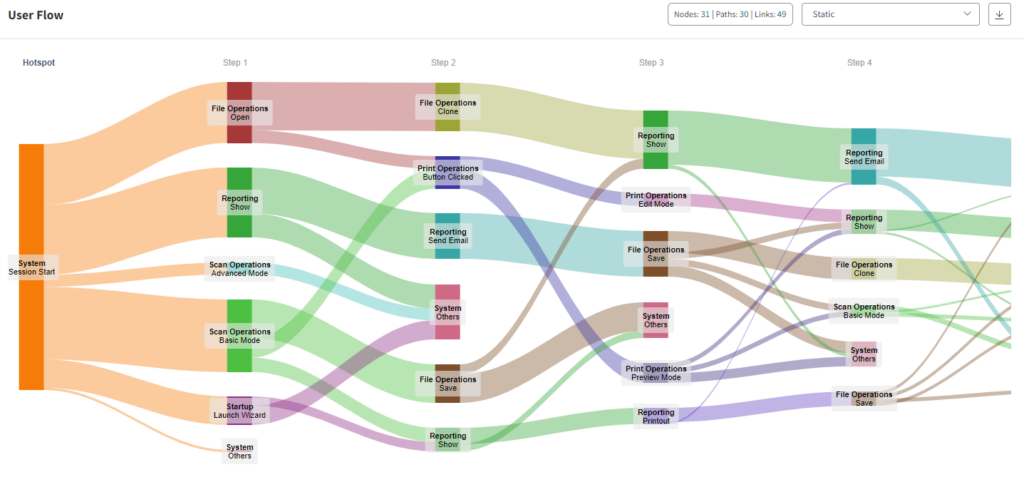
User flow reporting in Revenera Usage Intelligence
Those who’ve successfully made the transition to SaaS models often reference the 80/20 Pareto Principle, i.e., 80% of value is derived from just 20% of what you do.
The 80/20 rule is broadly applied across the business world, and taking time to evaluate usage data will strengthen your monetization initiatives by highlighting the 20% of capabilities you should really focus on when drafting your development roadmap.
Additionally, these insights can improve your product positioning, ensuring your go-to-market strategy is rooted in data, allowing you to target the right personas with messaging that showcases practical use cases.
Read the eBook:
Take the Guesswork out of Product Management
Centralized Entitlement Management
A fundamental consideration for every on-premises to SaaS transition is how to govern customer entitlements across your portfolio, i.e., controlling access in accordance with contract terms.
Some organizations choose to run individual enforcement systems for each product line, maintaining separate solutions for on-premises, hybrid, and SaaS deployments, which all require dedicated fulfillment and data collection mechanisms.
However, this siloed approach creates a disjointed experience – both for internal and customer reporting – with no centralized visibility into entitlements and usage, potentially impacting revenue recognition, compliance, and renewals.
As such, the transition to SaaS is your opportunity to streamline operations with purpose-built entitlement management software, allowing you to consolidate disparate systems into a unified platform that provides a ‘single pane of glass’ for all deployments, as illustrated here:
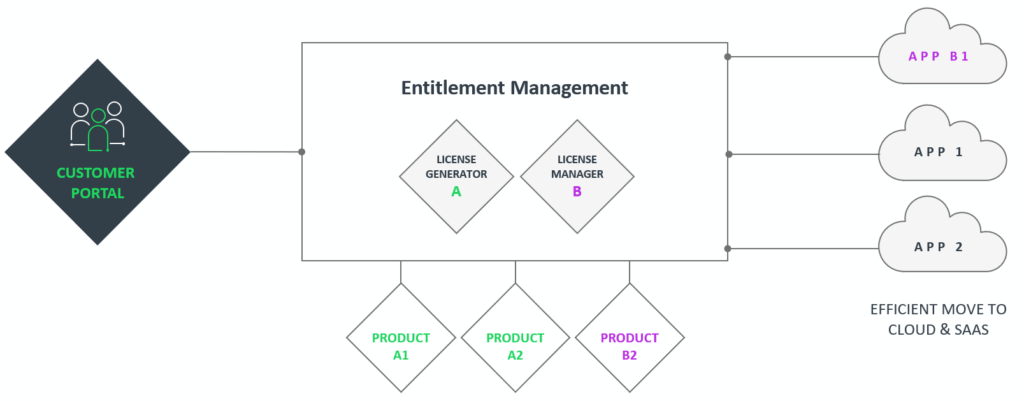
An Entitlement Management framework for both on-prem and SaaS deployments
The ability to manage SaaS use rights alongside on-prem entitlements enables you to offer flexible pricing and packaging options, easily bundling products together – regardless of deployment and monetization models – to meet varying customer needs.
A centralized entitlement management system also facilitates end customer self-service, allowing administrators to allocate use rights and monitor utilization rates, enhancing the user experience and reducing support calls.
In the modern world, customers expect usage data transparency, ensuring they can track adoption to gauge value and stay on top of contractual obligations, avoiding surprise bills in the event of overuse. Openly providing these insights has dual benefits for both buyers and suppliers, so centralizing entitlement management should be a cornerstone of your SaaS transition strategy.
Watch the webinar with IDC’s Mark Thomason:
Mastering Software Entitlement Management and Improving Operational Efficiency
Exceeding Customer Expectations
Customer Success has become a critical function for SaaS providers, as today’s buyers expect uninterrupted services that deliver continuous value.
Customer Support is generally a reactive discipline, firefighting issues as they arise, but Customer Success should be proactive from day one – helping users gain immediate value in the onboarding process, and communicating changes or potential outages ahead of time to help them prepare.
Closely aligned to Support, Product, and Engineering, Customer Success Managers (CSMs) are vital as you transition to SaaS model deployments, relaying customer concerns, ideas, and requests to the right people to ensure your platform is primed for growth with strong retention as you proactively control your SaaS churn rate.

SaaS monetization revolves around the guiding principle of growing Annual Recurring Revenue (ARR), allowing you to better forecast for the future in comparison to traditional, perpetual sales that are ‘lumpy’ in nature.
As such, Customer Success teams need to be laser-focused on renewals, developing long-term relationships that are dedicated to delivering value.
Access to usage data is essential, allowing CSMs to have informed conversations about utilization rates and how to maximize value, while also monitoring at-risk accounts with low activity in a bid to avoid churn. Again, this is where centralized entitlement management supports the move to SaaS.
Share this with your friend in Finance:
The CFO’s Ultimate Guide to Successfully Moving to SaaS
SaaS Transition Consultancy
The transition from perpetual to SaaS frameworks can be a rocky road, but the Revenera team has vast experience in helping suppliers introduce cloud deployments with flexible software licensing solutions that allow you to adopt new, hybrid monetization models.
Following the steps outlined above will allow you to:
- Grow ARR with a platform that enhances your most compelling use cases
- Streamline operations with a single system of record for data and insights
- Reduce time-to-value and increase retention with Customer Success
Whether your on-prem customer base knows it or not, they can drive your SaaS transition roadmap with telemetry data that reveals your most compelling features, as Extensis found when they embedded the ‘Voice of the Customer’ into Development.

Revenera Monetization Monitor: 2026 Outlook
501 senior leaders at global technology companies share their thoughts on monetization trends for 2026 and beyond. See the results >>>
Achieving a ’cause and effect’ understanding of how and why customers use your product, breaking down silos by consolidating back-office infrastructure, and committing to build long-term relationships will boost revenue optimization, which should be the ultimate goal as you transition to SaaS.
Your journey to the cloud may have been delayed, but as the ancient Chinese proverb suggests:
The best time to plant a tree was 20 years ago.
The second-best time is now.
Common Questions
Why are software suppliers planning a transition to SaaS?
According to the 2025 Monetization Monitor, 61% of software suppliers plan to increase SaaS deployments by 2026. This shift is driven by the growing need for flexibility, especially as remote work becomes more prevalent. On-premises software often lacks this flexibility, creating pressure for suppliers to move to cloud-based models.
What role does usage analytics play in a successful SaaS transition?
Usage analytics provides objective insights into how customers use your software, highlighting the most valuable features and those with low adoption. Without this data, SaaS transitions often rely on guesswork. Tracking feature usage and analyzing user flows help prioritize development efforts and refine product positioning based on real customer behavior.
Why is centralized entitlement management important during SaaS migration?
Centralized entitlement management consolidates disparate systems into a unified platform, offering visibility into entitlements and usage across all deployments. This approach streamlines operations, supports flexible pricing and packaging, and enables customer self-service. It also ensures transparency in usage data, helping customers avoid unexpected costs and improving compliance and renewals.
How does Customer Success differ from Customer Support in SaaS models?
Customer Support is reactive, addressing issues as they arise, while Customer Success is proactive, focusing on delivering continuous value from day one. Customer Success Managers (CSMs) help onboard users, communicate changes, and monitor usage data to prevent churn.
What are the key steps to ensure a smooth SaaS transition?
Leverage usage analytics to identify high-value features and guide your roadmap, implement centralized entitlement management for streamlined operations, and prioritize Customer Success to reduce churn and increase retention.
If you need advice on your SaaS transition project, our expert team is only a contact form away.
In the meantime, you may find these resources helpful: