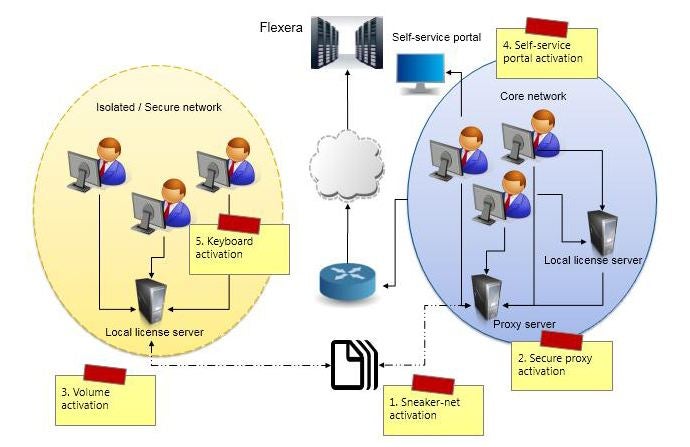

Today, many software applications require an end user to go through a software licensing activation process. The ultimate goal of an activation process is to reduce or minimize software piracy, in other words, to prevent the sharing of software between people in a way that infringes on the software’s end-user license agreement (EULA). The activation process becomes much more challenging in a disconnected network environment (i.e. branch offices and/or high-security zones within a production or core network environment), since these disconnected network segments are air-gapped or separated by a firewall that limits or prevents communication to and from other network segments (see diagram).
Alternative Options to Product Activation
If you are an application producer that requires support in such an environment, you should consider alternative options to product activation. Here are a few things to consider:
1. Sneaker-net activation
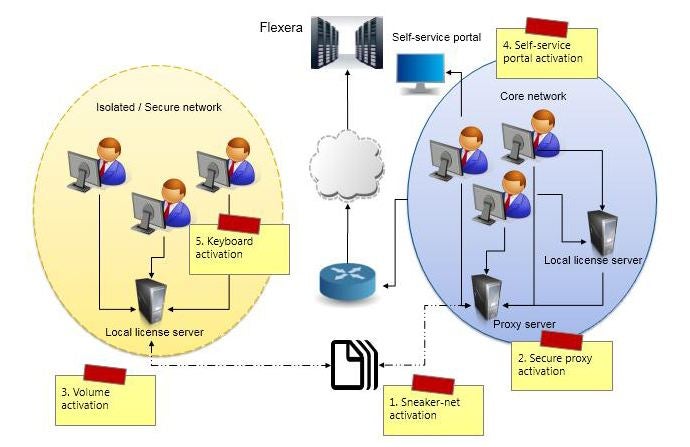
The most common product activation method to support the disconnected network. This involves exchanging a file between the entitlement system and the endpoints. In the exchange, the endpoint would provide the machine fingerprint of the system and the entitlement system would generate the appropriate license for the specific system. The end user in this case would be responsible for transporting the file between the entitlement management system and the endpoint.
2. Secure proxy activation
In most cases, the network administrator would have a secure proxy server that would allow a controlled connection to the Internet due to security policy to ensure data privacy. This process is similar to the normal activation process in the connected environment, with an additional step that the application must establish and be authenticated to the proxy server first.
3. Volume activation and transfer
In some cases, especially in large enterprise deployments, the ability to automate activation for hundreds and maybe thousands of applications can be an overwhelming task for an administrator if the only option is through a sneaker-net approach. To overcome this, an alternative approach would be to leverage the local license server to automate the software license activation process. So, instead of the application calling home to the entitlement management system over the Internet, the application would exchange the activation information with the local license server to activate.

Revenera Monetization Monitor: 2026 Outlook
501 senior leaders at global technology companies share their thoughts on monetization trends for 2026 and beyond. See the results >>>
4. Self-service portal
Similar to sneaker-net activation, the most common way of activation in a disconnected environment is to allow the actual end user to self-activate their application. Usually, credentials and activation keys are provided to the end user during the order process. The end user is given a set of instructions, usually about going to a web portal, entering their activation key, and downloading the license for their application.
5. Keyboard-only activation
In rare cases, especially when dealing with any government entities, there is absolutely no digital exchange between the isolated network to the outside world. Most of the time, the only input device is a keyboard. This model involves exchanging machine fingerprint information and activation keys over non-digital media (e.g. paper), so that an end user in this secure environment is able to enter in the activation key in order to activate the software product.
Applications are everywhere, and product activation is one solution to combat against software piracy. With Revenera’s Software Licensing Solutions multiple disconnected and in-product activation scenarios are supported. The range of support spans from simple disconnected systems to highly secure environments where no information about the environment is ever allowed to leave.
What types of product activation processes does your organization offer? What do your end-users prefer?
Common Questions
Why is software licensing activation important?
The main goal of a software licensing activation process is to reduce or minimize software piracy by preventing unauthorized sharing of software that violates the end-user license agreement (EULA).
What makes activation challenging in disconnected network environments?
Disconnected environments, such as branch offices or high-security zones, are often air-gapped or separated by firewalls that limit communication. This makes traditional online activation difficult and requires alternative methods to ensure compliance without compromising security.
What are common activation methods for disconnected networks?
Several approaches exist, including sneaker-net activation, where files are manually exchanged between systems; secure proxy activation, which uses a proxy server for controlled Internet access; volume activation via a local license server for large deployments; self-service portals for end-user activation; and keyboard-only activation for highly secure environments where no digital exchange is allowed.