
AI Monetization Strategy, Done Right
A Practical Guide for Product and Pricing Leaders
Jump to a Section
- Introduction
- Balancing Costs to Drive Profitability
- AI Pricing Strategy Evolution
- Managing Hybrid AI Pricing Strategies
- Growing Revenue with Data Insights
- The Prepaid vs. Postpaid Debate
- Visibility is the Foundation of Trust
- Triple-A Data Confidence
- Monetization Architecture Matters
- 6 Steps to Make Usage-Based Pricing Work
- Practical AI Monetization Advice
Introduction
As software producers develop and refine their AI monetization strategy, traditional pricing models are under pressure, with rising infrastructure costs, unpredictable usage patterns, and evolving customer expectations making it harder to determine the right approach.
This guide outlines how product and pricing leaders can achieve sustainable AI profitability by aligning pricing, usage, and cost structures, with a focus on:
- Balancing Costs to Drive Profitability
Understand the economic realities of delivering AI and why aligning pricing to consumption is becoming unavoidable. - Hybrid Monetization Strategies
Learn how to combine subscriptions and usage-based pricing to balance flexibility, scalability, and margin control. - Growing Revenue with Data Insights
Review usage, entitlement, and customer behavior data to refine pricing, guide packaging decisions, and uncover new revenue opportunities. - The Prepaid vs. Postpaid Debate
Evaluate the pros and cons of each approach and how they impact revenue predictability, customer experience, and risk. - 6 Steps to Make Usage-Based Pricing Work
Apply six practical steps to operationalize consumption-based pricing with the right data, systems, and governance in place.
With the world of AI monetization still in its early stages, you need to build models that are commercially viable today and adaptable as the market matures. This guide offers practical advice from Revenera’s team of software monetization experts.
Balancing Costs to Drive Profitability
After surveying 501 product leaders, Revenera’s Monetization Monitor 2026 indicates 70% of those who currently offer AI-driven capabilities are struggling with delivery costs – particularly cloud spend – undermining profitability.
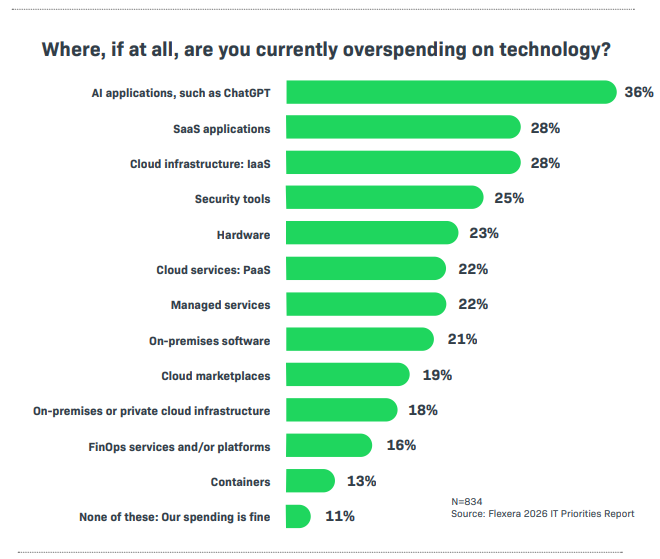
Meanwhile, Flexera’s IT Priorities Report highlights tension from the buyer’s perspective, with 36% of enterprise IT decision-makers believing they overspend on AI applications – the single biggest area of over-investment.
We’re at a critical juncture, as both buyers and suppliers feel the strain of a financial paradox where each side reports a raw deal, forcing a strategic rethink on how AI is priced, packaged, and delivered.
AI Monetization Strategy Evolution
During the first wave of innovation, many tech companies introduced AI capabilities to existing products and subscriptions, enabling fast launches and early experimentation.
However, as the landscape matures and operational expenses are factored in – from cloud resources and compute power to data modeling and performance enhancements – there’s been a shift toward usage-based pricing models that ensure overheads are covered while providing more control over consumption.
Although subscription remains the most common framework for AI today, the Monetization Monitor forecasts pure subscription plans to decline by five percentage points over the next 12 months, with a more nuanced AI monetization strategy emerging in the form of blended subscription and usage-based models, which are set to grow by 5%.
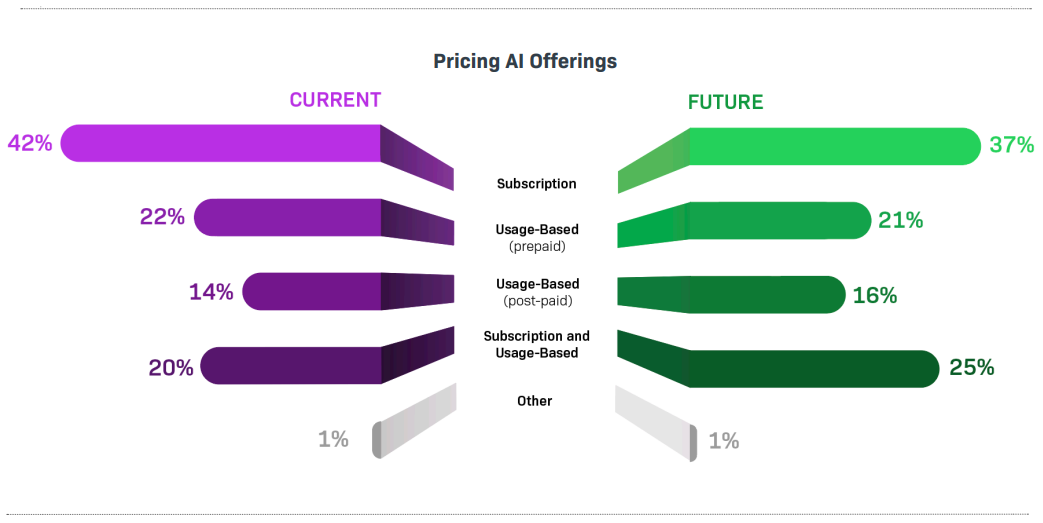
In total, usage-based approaches – whether prepaid, postpaid, or combined with subscriptions – are set to make up 62% of all AI product pricing strategies by 2027, marking a shift away from traditional software licensing models.
On the surface, adopting a consumption mindset solves the issue of squeezed margins, as producers can set prices to ensure resource‑intensive AI functionality is appropriately charged. Furthermore, as cost is directly linked to usage, customers can measure value more accurately, potentially alleviating concerns around overspending.
However, implementing a usage-based AI monetization strategy requires careful execution, as it carries inherent risk while also generating insights that can unlock new revenue opportunities.
Managing Hybrid AI Monetization Strategies
Much in the same way that bundling high-cost AI features into subscriptions risks eroding profitability, consumption-based licensing creates uncertainty as revenue becomes more unpredictable.
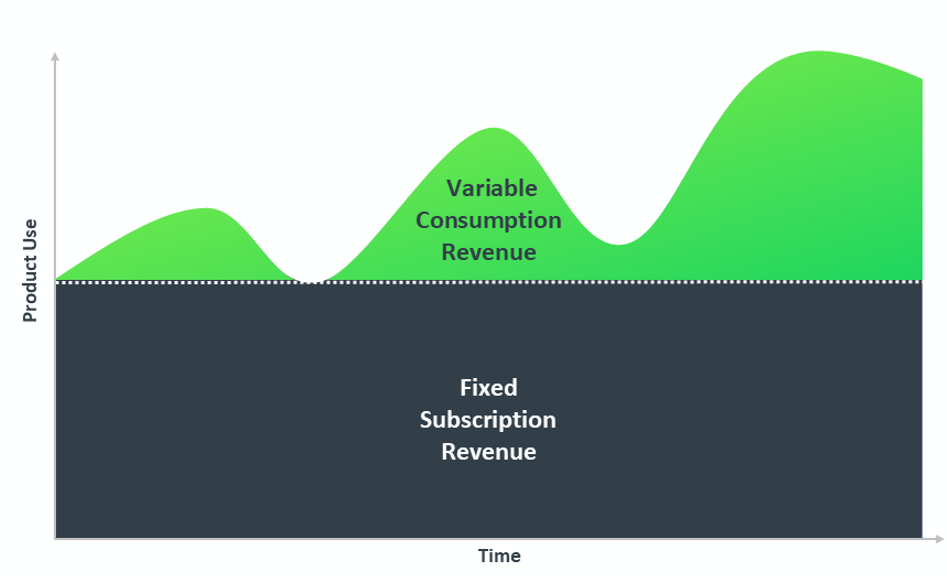
This is why many companies are evaluating hybrid models that combine subscriptions with consumption-based elements, offering core features through annual or monthly plans while providing AI capabilities on a pay-per-use basis.
Consumption Pricing to Monetize the Value of Premium Features
Protect the bottom line where costs impact profitability
Blend consumption with subscription
Analyze consumption data to see what’s driving value
This layered approach maintains recurring revenue for standard access while mitigating costs for premium functionality.
Benefits aren’t limited to cost recovery, though, as selling units of usage (i.e., credits, consumptive tokens, API calls, or whatever terminology you prefer) introduces a flexible revenue stream that scales with demand, making this a commercially viable AI monetization strategy that supports sustainable growth.
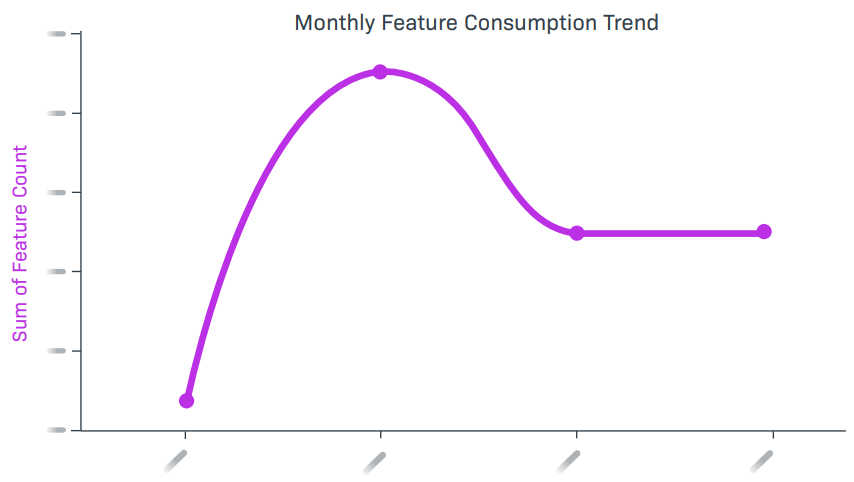
The biggest growth lever, however, lies in the depth of information captured by usage‑based systems, allowing product leaders to conduct meaningful customer data analysis that identifies value drivers, highlights differentiators, and guides roadmap innovation.
Growing Revenue with Data Insights
While there’s urgency to adopt an AI monetization strategy that aligns profitability with value – especially amid ongoing media speculation about the durability of AI investment levels – data‑driven software producers are looking at the bigger picture: not simply balancing costs, but studying usage to understand customer outcomes and benefits.
This strategic approach turns raw data into actionable insights, enabling you to:
- Pinpoint high-impact features: identify which capabilities drive adoption and deliver the greatest customer value.
- Refine pricing and packaging: align pricing to actual use.
- Strengthen retention: detect underutilized features and proactively reduce churn.
- Prioritize innovation: direct roadmap decisions toward high‑impact areas.
- Unlock growth: uncover upsell and cross‑sell opportunities based on usage signals.
When customer outcomes are clearly understood and continuously optimized, usage-based revenue becomes easier to scale over time.
The Prepaid vs. Postpaid Debate
While the benefits of consumption models are widely recognized, there continues to be debate around whether prepaid or postpaid structures are best. Producers grounded in subscription models benefit from upfront payments, which establish a predictable, evenly distributed revenue recognition cycle. By contrast, a purely postpaid AI monetization strategy exposes you to fluctuating usage habits, resulting in sporadic revenue.
Research has long suggested that customers prefer postpaid agreements, as they avoid upfront commitment and can justify costs after experiencing value. More recently, however, analysts have noted a shift in buyer sentiment. Prepaid models are gaining acceptance as organizations recognize the need to control spend – committing to a defined budget and limiting usage accordingly.
With appropriate guardrails in place, prepaid consumption can be distributed more evenly across a business period, stabilizing expenditure for customers while creating a more predictable revenue pattern for suppliers.
This shift in buyer preference may be a reaction to “bill shock” – a common risk in postpaid models when sudden usage spikes translate into unexpectedly high invoices, which can be particularly expensive for compute-intensive AI workloads.
Whether tracking consumption for prepaid models or building visibility and trust for postpaid billing, the fundamental need is real-time visibility into consumption data, enabling proactive controls, clearer communication, and fewer surprises.
Visibility is the Foundation of Trust
AI doesn’t behave like traditional software, and neither does its usage.
Tasks once handled by individual users are increasingly executed by AI agents, often operating continuously and in coordination with one another. These agents can invoke services at scale, generating volumes of activity that far exceed human-driven interaction.
That shift matters for your AI monetization strategy. Pricing models built around “per user” assumptions risk underestimating activity while infrastructure costs continue to climb, whereas usage-based pricing grounded in real-time data ties revenue to actual consumption – whether driven by people, agents, or a combination of the two.
Real-time usage data ensures transparency so customers can see usage as it happens, allowing them to understand which teams, users, or agents are driving consumption, and apply internal governance before costs escalate. Without this visibility, usage-based billing can feel opaque and risky – particularly in postpaid models.
For producers, visibility is just as important. New AI features rarely come with reliable usage baselines. Real-time data allows teams to monitor early adoption, detect anomalies, and project trends before those capabilities are fully commercialized. In that sense, usage data becomes more than a billing input – it’s a readiness signal that informs product rollout, customer communication, and pricing.
Triple-A Data Confidence
For consumption billing to be accurate and defensible, the data must meet three criteria:
- Accessible: Usage data must be readily available to both internal teams and customers.
- Attributable: Consumption should be traceable to a specific action – whether a user request, an AI agent invocation, or an automated background task.
- Auditable: Data must accurately reflect what occurred, giving producers confidence in their invoices and customers clarity on what they’re paying for.
Without these qualities, usage-based pricing quickly breaks down. Disputes increase, trust erodes, and finance teams lose confidence.
Monetization Architecture Matters
The choice between prepaid and postpaid models has architectural consequences.
Prepaid models rely on upfront credit purchases that are drawn down as usage occurs. While this eliminates surprise bills, it requires strong “showback” capabilities – real-time visibility into how balances are being consumed.
Postpaid models reverse the flow. Usage is captured first and billed later, placing heavy demands on real-time, high-fidelity usage capture. Gaps in accuracy or latency can lead to delayed invoices, disputes, or revenue leakage.
Monetizing AI often combines both approaches. A common strategy is prepaid access up to a defined threshold, with postpaid “overages” applied when usage exceeds that limit. This model is typically applied where trust is high or when uninterrupted service is critical for customers, even after prepaid rights are exhausted.
In all cases, best practice is to separate usage capture from billing logic. Usage data should be collected, normalized, and enriched in a dedicated layer, then passed downstream to billing platforms as needed.
This separation becomes especially important for organizations operating multiple billing, ERP, or CRM systems – often the result of growth through acquisition. A unified usage layer enables a consistent AI monetization strategy across the portfolio without first consolidating every downstream platform.
Tying this in with an entitlement management system, which records and tracks all monetization activity – perpetual, subscription, and usage – creates a single view to make sense of the entire portfolio across the business, as well as at individual account levels.
6 Steps to Make Usage-Based Pricing Work
Launching usage-based monetization isn’t just a pricing exercise, it’s a business transformation. Here are six steps to getting it right, and what to watch out for.
1. Define What “Usage” Means for Your Business
Why it matters: Consumption is one of the most disputed terms in pricing because there’s often disagreement on what the metric should be and how exactly it should be monetized. If stakeholders aren’t aligned, projects stall or fail.
Watch out for: Conflicting definitions between product, pricing and technology teams. Sales teams may also need convincing on the approach, so it’s crucial to get their buy-in.
Pro Tip
Document your definition early and get sign-off. Decide if usage is prepaid or postpaid, if caps apply and how overages are handled.
2. Secure Executive Alignment
Why it matters: Nearly 50% of projects fail because the C-suite isn’t fully on board. Usage-based pricing impacts ARR, the sales methodology, revenue recognition and finance processes.
Watch out for: Objections from CFOs or the board worried about predictability or Sales leaders worried about their sales process or quota achievement.
Pro Tip
Bring Finance and Sales into the conversation early. Model best-case, conservative and medium scenarios. Don’t just show great growth expectations; be transparent about potential revenue dips and volatility.
3. Bring Customers Along
Why it matters: Customers hate surprises. If they can’t predict costs, they’ll push back.
Watch out for: Introducing a new model without giving customers visibility into their usage history or abrupt launches without a customer and partner feedback cycle.
Pro Tip
Start with usage reporting before monetization. Show customers their patterns for 3–6 months so they can plan.
4. Choose the Right Technology
Why it matters: Engineering will often say it’s easy to build, but homegrown solutions often create technical debt, incorrect reporting and inconsistent experiences.
Watch out for: Disjointed customer experience across product lines, insufficient integration and automation and unreliable usage tracking.
Pro Tip
Invest in systems that deliver reliable telemetry, audit trails and standardized views for entitlement vs. consumption across all product lines.
5. Understand the Data
Why it matters: Pricing on assumptions is risky. Not every feature lends itself to a consumption model.
Watch out for: Basing metrics on what Product Managers think is valuable instead of what customers actually use.
Pro Tip
Collect telemetry data early. Validate usage patterns and seasonality before setting rates and take a broader customer cohort into account for modeling to capture different usage patterns and types across customer size, industry, etc.
6. Start Small and Iterate
Why it matters: A “big bang” rollout can backfire if rates or metrics are off.
Watch out for: Locking in rate tables without room for iteration.
Pro Tip
Launch with a small customer set, apply simple rate tables and refine based on feedback.
Practical AI Monetization Strategy Advice
Revenera’s Dynamic Monetization is designed with flexibility in mind, supporting hybrid approaches that extend beyond flat-fee subscriptions. In this short video, Revenera’s Jim Berthold demonstrates how it enables AI monetization via consumptive tokens:
By delivering scalable, real-time, and auditable usage capture, Dynamic Monetization supports both prepaid and postpaid AI monetization strategies. It decouples usage measurement from billing systems, operates across complex environments – including connected and air-gapped deployments – and provides the transparency customers increasingly expect.
Crucially, Dynamic Monetization also empowers producers to make changes at speed. Rate tables can be instantly adjusted and new packaging configurations quickly introduced, providing agile flexibility to adapt pricing and monetization strategies as usage patterns and cost structures evolve.
With adjustable rate tables, real-time data, strong guardrails, and easy API integrations, Revenera’s Dynamic Monetization provides a flexible platform to scale your AI monetization strategy.
If you you’d like expert guidance on monetizing AI and to learn more about Dynamic Monetization, please contact us to arrange a discovery call.
Frequently Asked Questions (FAQs)
AI monetization is the process of turning AI-driven capabilities into sustainable revenue through the right pricing, packaging, and licensing models. It matters because AI workloads are costly to run, especially with rising cloud and compute costs, and traditional flat-fee or user-based models often fail to reflect real usage. By aligning price with consumption and value delivered, software producers can protect margins while giving customers clearer ROI. Done right, AI monetization becomes a growth lever, not just a cost-recovery mechanism.
The best way to price AI features is to connect your pricing metric to actual consumption and perceived value, not just seats or generic access. Many organizations are moving to hybrid models that blend subscriptions for core functionality with usage-based pricing for AI-heavy capabilities. This allows you to recover infrastructure costs while offering flexibility and scalability to customers. Start by defining what “usage” means for your product, validating it with data, and then testing your pricing with a limited customer set before broad rollout.
Usage-based pricing for AI charges customers based on how much of a capability they consume, such as API calls, tokens, credits, or other measurable units. Instead of paying a flat fee, customers pay in proportion to their actual usage, which better aligns cost with value and supports scalable growth. For AI workloads, this model helps cover expensive compute and cloud costs that can spike unpredictably. It also generates rich consumption data, which can be used to refine pricing, identify high-value features, and uncover upsell opportunities.
Prepaid AI pricing requires customers to purchase credits or capacity upfront and draw down against that balance as they use AI capabilities. Postpaid pricing bills customers after the fact based on total consumption in a given period. Prepaid gives customers more control over budgets and can reduce “bill shock,” while giving suppliers greater revenue predictability. Postpaid offers flexibility and a low-friction start but can create volatility in revenue and invoices if usage spikes unexpectedly.
Neither prepaid nor postpaid is universally “better” — the right choice depends on your customers’ risk tolerance, your revenue goals, and the criticality of uninterrupted AI access. Prepaid is increasingly attractive as buyers look to control spend and avoid surprise invoices, especially for compute-intensive workloads. Postpaid can work well when trust is high and you provide strong, real-time visibility into usage. Many AI providers adopt a hybrid approach: prepaid up to a threshold, with controlled postpaid overages when that limit is exceeded.
Hybrid pricing models combine subscription (for baseline access) with usage-based elements (for premium AI features), balancing predictability with flexibility. This approach preserves recurring revenue from core capabilities while ensuring resource-intensive AI features are monetized in line with actual consumption. It also reduces margin erosion that can happen when expensive AI is bundled into flat-fee licenses. For customers, hybrid models can feel fairer because they pay more only when they use more.
Usage data shows exactly how customers interact with your AI features — which capabilities they rely on, how frequently they use them, and where adoption stalls. By analyzing this telemetry, you can identify high-impact features for upsell, refine pricing and packaging, and proactively address underutilization to reduce churn. Usage patterns can also guide roadmap decisions by spotlighting what truly drives value. Over time, data-driven insights help evolve your AI pricing from guesswork to a repeatable, optimized strategy.
The main risks of usage-based pricing for AI include revenue volatility, customer “bill shock,” and disputes if usage data is incomplete or unclear. Without real-time visibility, customers may feel out of control and view your pricing as opaque or risky. On your side, gaps in telemetry or latency can lead to incorrect invoices and revenue leakage. Mitigating these risks requires accurate, auditable, and accessible usage data, along with clear communication and guardrails like alerts, caps, or budgets.
To support AI monetization at scale, you need reliable usage telemetry, a dedicated usage data layer, and an entitlement management system that tracks what each customer is allowed to consume. This usage layer should collect, normalize, and enrich data independently of your billing engine, then feed downstream systems like billing, ERP, and CRM. That architectural separation lets you evolve pricing and packaging without rebuilding your financial stack. It also creates a single, consistent view of entitlement vs. consumption across your product portfolio.
Launching usage-based pricing is a business transformation, not just a price change. Start by clearly defining what “usage” means, aligning executive stakeholders, and socializing the model with Sales and customers. Collect telemetry early, run pilots with a small customer cohort, and validate your metrics, seasonality, and rate tables before a wider rollout. Invest in technology that delivers trustworthy, real-time, auditable usage data and be prepared to iterate your pricing as you learn from the market.
Resources
Video
Honeywell Transitions from Hardware Sales to Software Monetization
See how Honeywell achieved over 100% growth in annual software revenue while accelerating time-to-market and supporting hybrid models.
eBook
The Build vs. Buy Debate: A Product Manager’s Guide to Software Monetization Solutions
To build, or to buy? That’s the question technology companies typically face when evaluating solutions for software licensing, entitlement management, and compliance – and getting these factors right is essential for success. Download our guide to learn more and discover which option makes the most sense for your business.
White Paper
The CFO’s Ultimate Guide to Successfully Transitioning to SaaS
This Guide is a valuable primer for CFOs (and those that need insight into CFO priorities) that are on the path to SaaS deployment and subscription monetization models. Learn which metrics to focus on, and how to change your business’ operations to accommodate SaaS.
Want to learn more?
See how Revenera's Software Monetization Platform can help you take products to market fast, unlock the value of your IP and accelerate revenue growth.