


Engineering teams don’t need convincing that billing is hard.
Recently, I read an article from Lago Billing – “Why Billing Systems Are a Nightmare for Engineers”, which clearly explains that what starts as “simple subscription billing” quickly turns into a maze of proration rules, usage calculations, retries, refunds, tax compliance, edge cases, and race conditions. Billing systems live at the intersection of money, contracts, and time, and that alone is enough to keep teams busy for years.
Yet many companies make software billing even harder by asking it to do more than it was ever designed to do.
One of the most common and costly mistakes?
Embedding entitlement management inside the billing system.
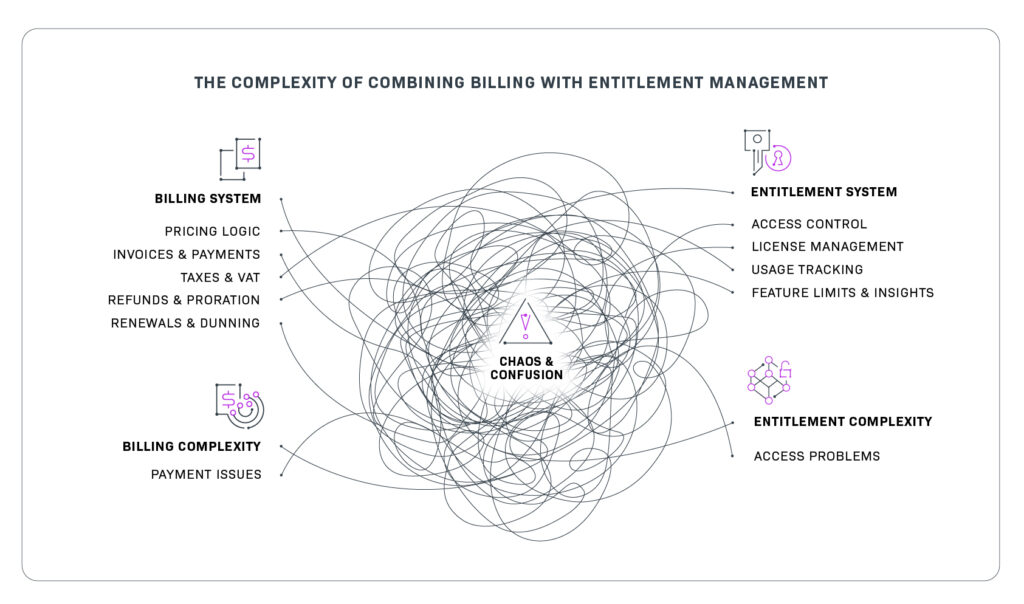
Software Billing and Entitlements Solve Different Problems
Let’s be very clear: billing and entitlement management are not the same thing.
Billing answers one question:
How much does the customer owe us, and how do we collect it?
Billing systems are responsible for:
- Pricing calculations
- Invoices and payments
- Subscriptions and renewals
- Usage aggregation for charges
- Taxes, credits, refunds, and revenue recognition
This domain is already complex and highly regulated. Any added responsibility increases risk and slows engineering velocity.
Entitlement management answers a very different question:
What this customer is allowed to use, and how they are actually using it?
Entitlement management focuses on:
- Who can access which products, features, or bundles
- Usage rights across SaaS, on-prem, embedded, and hybrid deployments
- License enforcement and fulfillment
- Tracking real usage against purchased rights
- Providing insight into adoption, expansion, and compliance
Trying to force this logic into a billing system is like asking your payment gateway to manage feature flags and access control. It’s the wrong abstraction, and this is evident over time.
Why Mixing Entitlements into Software Billing Systems Makes Everything Worse
“Billing answers who pays and how.
Entitlements answer who can do what. Mixing them is like asking the cashier to run security.”
When entitlement logic is buried inside billing systems, teams start to experience:
- Tightly coupled code paths where a pricing change can break access control
- Slower releases because billing changes are high-risk
- Poor visibility into real product usage
- Workarounds and spreadsheets to track who is entitled to what
- Billing systems turning into pseudo-licensing engines, which they were never designed to be
The result is not just technical debt, it’s monetization debt. Teams lose the ability to evolve pricing, packaging, and product strategy quickly.
How Pricing, Software Billing, and Entitlements Should Work Together
The right approach is not “either billing or entitlements.”
It’s a clear separation with strong integration.
A healthy model looks like this:
- Pricing lives in billing
- Plans, tiers, usage rates, discounts, invoices
- Entitlements live in an entitlement management system
- Access rights, feature limits, usage rights, and enforcement
- Usage data flows from entitlements to billing
- Accurate, auditable usage signals not raw product noise
- Analytics inform business decisions
- Renewals, upsells, churn risk, and packaging strategy
Each system does what it does best, and together they enable modern monetization.
Why Entitlement Management Deserves Its Own System
Modern products are no longer simple. They have various complex requirements to support.
- SaaS + on-prem hybrid deployments
- Usage-based and outcome-based; hybrid pricing
- Feature-level packaging
- Device-based, user-based, and capacity-based models
- Customer self-service expectations, smooth integrations, and activations
Entitlement management becomes the source of truth for customer rights and product usage. It gives product, engineering, sales, and finance teams a shared understanding of:
- What was sold
- What was delivered
- What is actually being used
Without this clarity, monetization becomes guesswork.
How Revenera Gets This Right
Revenera’s entitlement management platform (FlexNet Operations) is built around one core idea:
Don’t overload software billing systems, empower monetization through entitlements.
What makes it effective:

Revenera Monetization Monitor: 2026 Outlook
501 senior leaders at global technology companies share their thoughts on monetization trends for 2026 and beyond. See the results >>>
- Designed for SaaS, IDM, and hybrid products
Supports subscriptions, perpetual licenses, usage-based models, and everything in between. - Centralized entitlement and usage visibility
A single source of truth across cloud, on-prem, and embedded environments. - Usage intelligence, not just enforcement
Monetization analytics help teams identify adoption gaps, expansion opportunities, and churn risk. - Clean integration with billing and CRM
Entitlements inform billing; they don’t compete with it. - Scales with business complexity
As pricing models evolve, entitlement logic doesn’t become a bottleneck.
This separation allows companies to move faster, price smarter, and monetize more effectively without turning billing into an unmaintainable monolith.
Final Thought: Complexity Is Inevitable, Confusion Is Optional
Software billing will always be complex.
AI and outcome-based pricing will always add a new nuance.
Hybrid monetization will always evolve.
But confusion comes from poor boundaries, not from complexity itself.
By keeping billing and entitlement management separate and letting each system excel at its purpose, you don’t just reduce engineering pain, you unlock better monetization.