


I’ve lost count of the number of times I’ve sat with product and engineering teams debating whether to build or buy software monetization systems.
The room starts optimistic. Someone sketches out a diagram on a whiteboard. A few APIs here, some licensing logic there, maybe a usage tracker bolted on. It all feels manageable. But as monetization models evolve and expectations change, the seemingly clean architecture turns into a tangle of workarounds.
From my perspective as a Solution Architect, the issue isn’t whether teams can build monetization systems. It’s whether they fully account for compounding complexity as they’re expected to drive growth in line with market trends.
This short video summarizes the key points you need to consider when deciding whether to build or buy software:
The Software Build or Buy Tipping Point
What makes this debate so fascinating right now is that the stakes have never been higher. Recurring revenue, consumption-based pricing, and AI-driven offerings are pushing companies to think carefully about how flexible and future-ready their systems need to be.
This is where custom software builds often struggle. In-house solutions are typically designed for a moment in time, optimized for a specific go-to-market motion. When strategies change, those systems can become a constraint rather than an enabler.
At the same time, the hesitation around buying a commercial platform is understandable. Teams fear losing control, even when roadmaps outpace what their tooling can realistically support. This tension fuels the build or buy software debate, and friction starts mounting as:
- Systems built around a single monetization model struggle to adapt
- Engineering becomes a bottleneck for pricing and packaging updates
- Product roadmaps start to bend around technical limitations
The issue of governance is also easy to overlook.
When software monetization technology is developed in silos, product teams often create their own approaches. One handles entitlements one way, while another tracks usage differently. Without clear, shared documentation, these differences are often understood only by the individuals who built them rather than being captured in consistent, repeatable processes.
What starts as autonomy can quickly turn into fragmentation. Over time, this lack of governance makes it harder to maintain consistency, visibility, and control across the business, while also being entirely dependent on individual expertise instead of well-documented, scalable frameworks.
The Cost Equation and the Bigger Picture
Cost discussions are often viewed too narrowly, with a focus on upfront investment rather than overall impact. However, the bigger effect plays out over time as the hidden costs of homegrown software stack up:
- Slower releases hinder your sales pipeline
- Ongoing maintenance pulls engineering away from innovation
- Limited analytics reduce the ability to uncover growth opportunities
I’ve seen how quickly simple requests snowball. A new pricing tier, more detailed reporting, greater packaging flexibility. All reasonable, but in a DIY system, each one can trigger weeks of rework, and what starts as a one-time investment quickly turns into a perpetual CapEx sinkhole.
Time spent maintaining the system is a distraction from driving innovation. And when the business needs to shift, the build or buy software conversation resurfaces, but now under pressure instead of from a place of control.
In contrast, commercial monetization platforms help you reduce technical debt with a more predictable OpEx model, where ongoing investment is aligned to value delivered rather than constant reconfigurations just to keep the lights on.
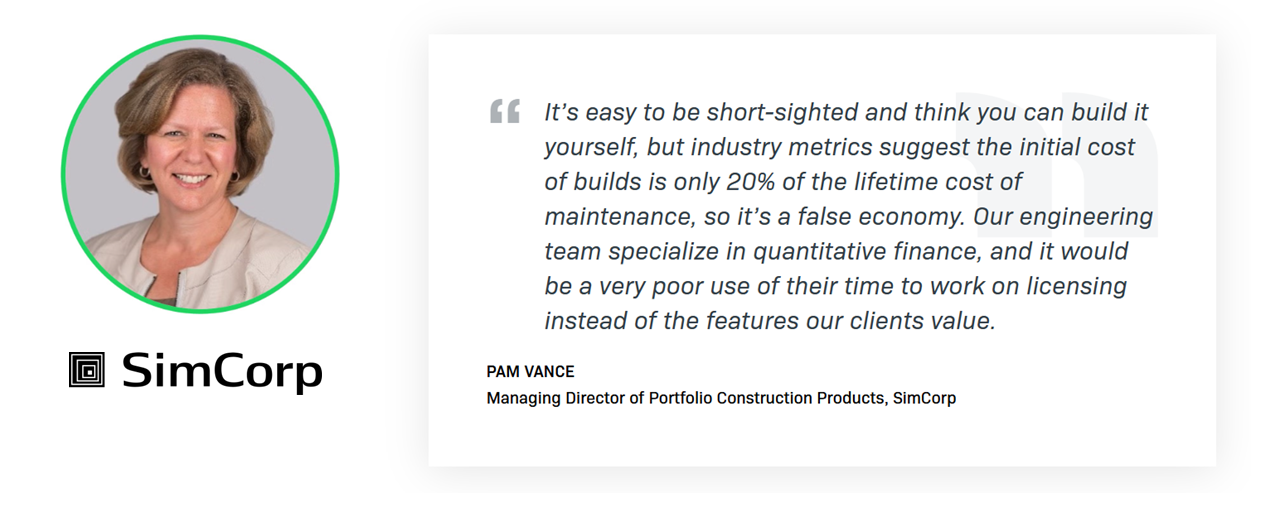
Read the Case Study: SimCorp Grows ARR with Capacity-Based Subscriptions
Control and Coordination
When monetization is treated as a shared capability rather than a set of product-specific implementations, teams gain consistency in how they package, price, and deliver software. They also benefit from centralized visibility into usage and entitlements, which makes it easier to adapt without reengineering multiple systems.
The benefits of a coordinated system include:
- Less duplicated effort across teams
- Centralized data improves visibility and decision-making
- Shared infrastructure supports faster, more consistent execution
Just as importantly, it improves the customer experience. Homegrown systems often result in clunky activation flows, limited or no self-service portals, and inconsistent entitlement management. These gaps don’t just create internal friction, they directly impact how customers interact with your product.
When you build everything yourself, you also take on all the responsibility that comes with it. Every update, every integration, every scaling challenge. Over time, that responsibility adds friction. It slows down how quickly you can respond to change, right when speed and adaptability matter most.
That’s the real tension in the build or buy software dilemma. It’s not just about what you can build, it’s about how quickly you can adapt without constantly reworking your foundation, allowing you to embrace new strategies like consumption licensing with relative ease.
Where Revenera Changes the Game
Many companies today aren’t operating in a single model. They’re managing SaaS, on-prem, and increasingly monetizing software in devices – often all at once. That’s a level of complexity most DIY systems weren’t designed to handle.
The challenges are rapidly increasing as organizations start experimenting with AI pricing models, where value isn’t always linear or predictable.
This is where Revenera’s monetization platform shifts the equation. Instead of forcing trade-offs, it gives you the flexibility and intelligence to move faster without losing control, with benefits including:
Hybrid Flexibility
Manage entitlements across on-prem, SaaS, and embedded environments while enabling hybrid monetization strategies such as subscription-plus-consumption with the flexibility to offer credit-based pricing for specific features or your entire portfolio of products.
Security and Compliance
Revenera is ISO 27001 certified, delivering enterprise-grade security, data protection, and compliance. Commercial platforms are designed to stay ahead, which is crucial as the EU Cyber Resilience Act and EU AI Act come into force.
Monetization Analytics
Go beyond basic reporting with built-in software usage tracking that shows how customers actually interact with your product. Use the insights to identify upsell opportunities, flag churn risk, and refine products based on real behavior.
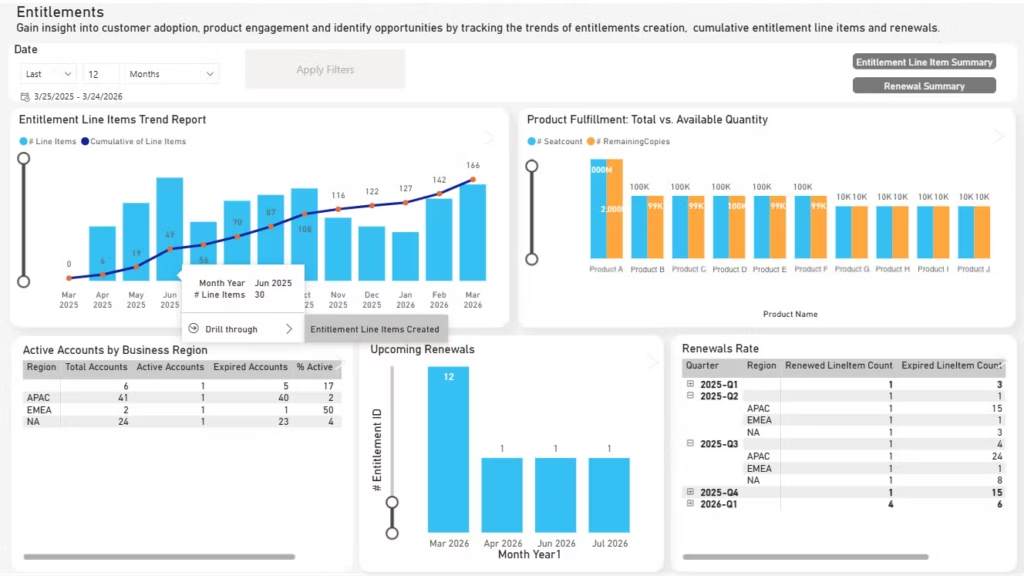
Example dashboard from Revenera’s Monetization Analytics
A More Strategic Approach
A homegrown system might get you pieces of this over time, but rarely all of it, and almost never without significant effort. More often, critical capabilities like revenue analytics or security get deprioritized in favor of getting something live.
This is where the build or buy software conversation evolves. It stops being about control for its own sake and starts being about what actually enables the business to grow.
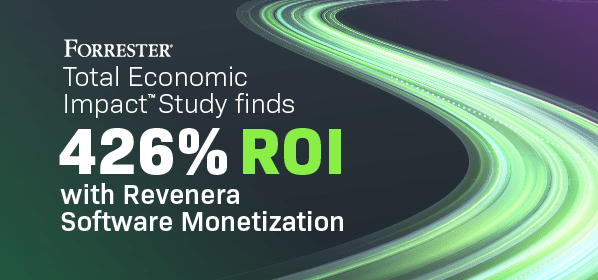
That’s where purpose-built platforms create a clear advantage. According to Forrester’s Total Economic Impact™ Study of Revenera, customers achieved a 426% ROI over three years, fueled by faster delivery, reduced operational overhead, and stronger monetization insights.

Revenera Monetization Monitor: 2026 Outlook
501 senior leaders at global technology companies share their thoughts on monetization trends for 2026 and beyond. See the results >>>
The Build or Buy Software Decision
Most companies take a measured approach to build vs. buy software decisions. They realize building everything internally isn’t sustainable, but they still want flexibility where it matters. The goal becomes less about total control and more about strategic control.
The teams that get this right tend to think differently. They focus on building what their customers love, what truly differentiates them from competitors, and choose to buy what accelerates time-to-market for everything else.
Because in the end, the build or buy software decision isn’t a one-off choice. It’s an ongoing strategy. And the companies that treat it that way are the ones that move faster and avoid getting stuck with systems that can’t keep up.
If you’re currently debating whether to build or buy software monetization infrastructure, feel free to reach out to Revenera to see how we can help.