


Software monetization is at an inflection point, as the challenge of AI licensing creates new layers of risk, uncertainty, and opportunity.
Traditional monetization strategies are struggling to keep pace with the demands of scaling AI-powered solutions. Costs are unpredictable, usage patterns are dynamic, and customers expect flexibility without surprises.
In this environment of rapid experimentation, producers face a critical question: How do you capture economic value while continuing to drive innovation?
The Economic Value Principle
At its core, AI licensing should ensure fair value for customers and sustainable profit for producers.
Historically, perpetual software licenses shifted most of the financial risk to the customer. Buyers paid upfront and then assumed responsibility for deployment, integration, maintenance and long-term infrastructure investment, regardless of whether the application ultimately delivered the expected business value.
Once the license was sold, the producer’s revenue was largely fixed. If the customer achieved exceptional outcomes, the producer did not participate in that upside. If the customer underutilized the software, the financial burden remained with them.
Subscription models improved this dynamic by lowering upfront commitments and spreading payments over time. However, they still rely on relatively stable cost structures. When underlying costs fluctuate significantly – as they do with AI workloads – fixed subscription pricing can create margin pressure for producers or misalignment with customer value.
Why Subscription Alone Isn’t Enough
AI breaks the assumption of delivery cost stability. Compute and storage requirements can spike unpredictably, so fixed subscription pricing (even if recurring) can erode margins.
Subscriptions also don’t serve customers well when usage varies significantly over time. Some customers overpay relative to value received, while others generate costs that outpace the subscription price. Neither scenario is sustainable.
AI is changing the economics of software. When customer usage directly impacts producer costs, AI pricing models must evolve accordingly.
AI Licensing: Aligning Price with Value
To address this shift, leading producers are moving toward hybrid AI licensing models that combine subscription foundations with consumption-based pricing.
This approach achieves four critical AI licensing goals:
- Fairness and Transparency: Customers pay for what they use, aligning cost with delivered value.
- Margin Protection: Producers recover variable costs without sacrificing profitability.
- Revenue Predictability: Subscription protects base ARR (Annual Recurring Revenue) while consumption captures upside.
- Flexibility for Innovation: Customers can adopt new AI capabilities without large upfront commitments.
In practice, this often means monetizing AI with prepaid/postpaid consumption layered onto a subscription base.
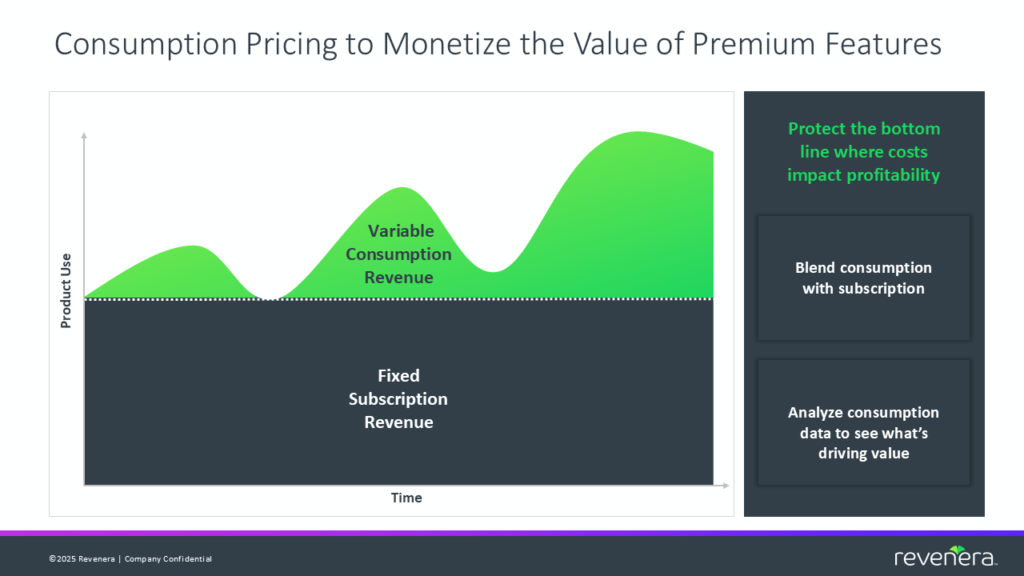
This approach also opens the door to premium pricing. When producers can tie pricing to measurable outcomes, they create economic value that customers are willing to pay for.
Revenera’s Role in Enabling Value Capture
Revenera helps technology companies implement hybrid AI pricing strategies through a combination of:
- Flexible Monetization Models: Node-locked, floating, metered, and token-based models tailored for AI and SaaS, with seamless hybrid combinations.
- Advanced Analytics for Value Reporting: Producers can measure usage and outcomes, enabling data-driven pricing decisions.
- Dynamic Monetization: Modern platforms designed for connected and regulated environments, supporting elastic access, surge pricing, and diverse deployment scenarios.
See how Revenera’s Dynamic Monetization enables flexible, usage-based AI licensing models in this short video:
The Road Ahead
The future of AI licensing agreements will be defined by strategies that align price with measurable value.
The industry is moving toward hybrid models that layer consumption or outcome-based pricing on top of traditional subscriptions. This evolution isn’t just about covering costs. It’s about capturing the full economic value of innovation.
Producers who embrace this shift will not only protect margins but also strengthen customer relationships by aligning price with measurable success.

Revenera Monetization Monitor: 2026 Outlook
501 senior leaders at global technology companies share their thoughts on monetization trends for 2026 and beyond. See the results >>>
Read Now:
AI Monetization, Done Right: A Practical Guide for Product and Pricing Leaders
Smarter AI Licensing Models
If you’re a software producer navigating the complexities of AI monetization, start by asking:
- How much risk are you removing for your customers?
- Can you measure and communicate the value you deliver?
- Are your monetization models flexible enough to adapt to unpredictable costs and dynamic usage?
Those who answer and act on these questions will lead the next era of software monetization and set the blueprint for AI business strategy.
If you’d like more information on how Revenera’s monetization platform enables consumption-based AI licensing models, please contact us today.