

Software producers often wonder whether they need a dedicated back-office application to facilitate software licensing and software entitlement management for the applications they sell in the marketplace. This blog explains where software entitlement management fits within an application producer’s IT portfolio.
Implementing an Entitlement Management System
There is no denying that software entitlement management is a specialized and complex process. If entitlements are not managed well, it may give rise to severe revenue and customer satisfaction implications, including IP leakage, license overage, and the possibility of significant service overheads. You can implement entitlement management software system processes in various ways:
- Extend an ERP, CRM, or service application
- Develop a ground-up homegrown application
- Buy a COTS (commercial off-the-shelf) application
The Entitlement Management Process
Software entitlement management, irrespective of what implementation path you choose, is a critical, independent, and integrated component in your IT application ecosystem. It deserves the rightful treatment in terms of investment and executive attention that would typically extend to a Tier I IT application.
The following illustration shows a generic Order to Entitlement process software application that producers may employ. The diagram depicts how entitlement management systems play a prominent role throughout many stages. Your specific scenario and IT application portfolio mix or directory may or may not resemble this entitlements process flow exactly, but probably has some parallels.
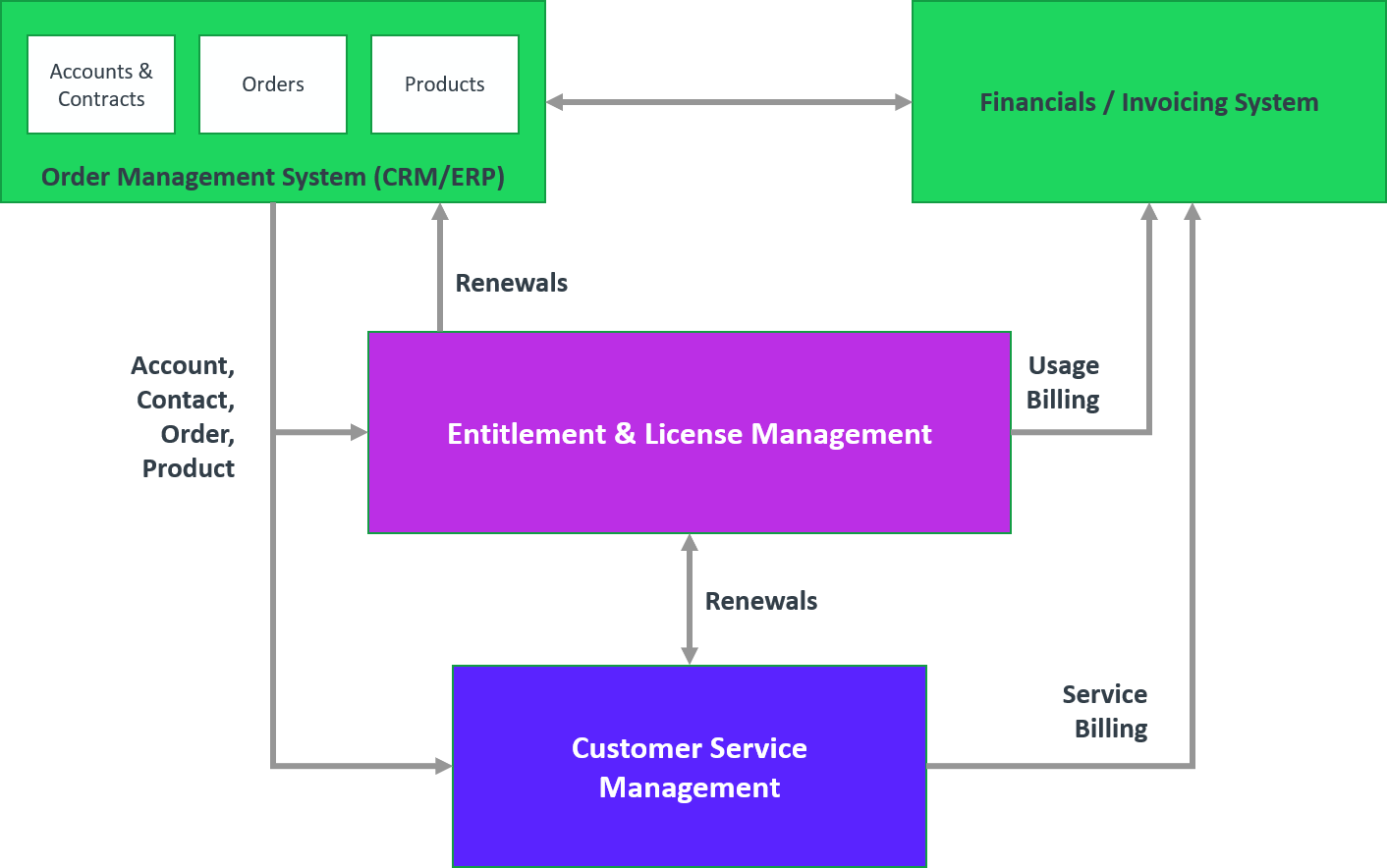
The Order to Entitlement management process starts off in the Order Management system (CRM or ERP), where a sales order is booked when the customer buys the product. The order is transferred to the Entitlement Management application along with account and contact details, where necessary entitlements are created for customers to perform software downloads, and control activation and lifecycle activities. Similar information may also be transferred to the Customer Service application so that customers are registered for the service they are eligible for.
If you have a product lifecycle management (PLM) application where you maintain products and product hierarchies, then you can load the product data into the entitlement management system via web services or a file-based upload. Product data can be manually entered and maintained in the Entitlement Management application as well.
If your company offers usage-based or subscription-based software licensing, the Entitlement management application sends usage information (in particular, entitled versus actual) to your Financials application for invoicing/billing. The Customer Service application interacts very closely with the Entitlement Management application during entitlement fulfillment, and more prominently, for maintenance renewals or upgrades. In some cases, renewal information is also sent to the Order Management application for the creation of service orders.

Revenera Monetization Monitor: 2026 Outlook
501 senior leaders at global technology companies share their thoughts on monetization trends for 2026 and beyond. See the results >>>
Manage Entitlement Like SCM Software Licensing
Business process flows across enterprise applications may have variations depending on your specific business requirements. By and large, the entitlement management application holds a key set of information pertinent to customer entitlements and absolutely needs tight integration with other major enterprise applications.
In short, Entitlement Management facilitates business functions similar to a conventional Supply Chain Management (SCM) software for application producers. Entitlement Management Software can either co-exist with your SCM application or provide basic SCM-like functionality on its own. Hence, Entitlement management should be given the equivalent management focus and investment you would provide to your supply chain application. This is true whether your company is an Independent Software Vendor (ISV) or an Intelligent Device manufacturer (IDM).
Revenera offers the world’s leading software licensing solutions and Entitlement management solution that have evolved over several decades, just like SAP or Oracle in the SCM field and encompasses industry-specific best practices from years of experience in the highly specialized licensing domain.
Its powerful software usage reports also allow targeted customer data analysis to inform product roadmap decisions and uncover upsell and cross-sell opportunities, or help you prevent churn.
Common Questions
Why is software entitlement management important for application producers?
Software entitlement management is essential because it ensures customers receive the correct rights to use and access the software they purchase. When entitlements are poorly managed, companies risk revenue loss, intellectual property leakage, license overages, and increased service overhead. A well-implemented entitlement management system helps maintain compliance, improve customer satisfaction, and streamline operational processes.
What are the common ways to implement an entitlement management system?
You can extend existing enterprise systems such as ERP, CRM, or service applications. Another option is to develop a homegrown application from the ground up. Alternatively, you can purchase a commercial off-the-shelf (COTS) solution, which often includes industry best practices and integration capabilities.
How does entitlement management integrate with other enterprise applications?
Entitlement management functions as a critical component within the IT ecosystem and integrates with several key systems. It works with Order Management systems like CRM or ERP to convert sales orders into entitlements. It connects to Customer Service applications for entitlement fulfillment and renewals. It also synchronizes product data with Product Lifecycle Management (PLM) systems and sends usage information to financial systems for billing and invoicing, especially for subscription or usage-based models.